// 2026-08-05 · Weird & Wonderful · by Bob Smith
Drive Me Insane: Turn On a Stranger's Lights Since 1997
Drive Me Insane lets anyone on the internet flip the lights, drive an RC car and pan the cameras in one man's house. It has been running since 1997.
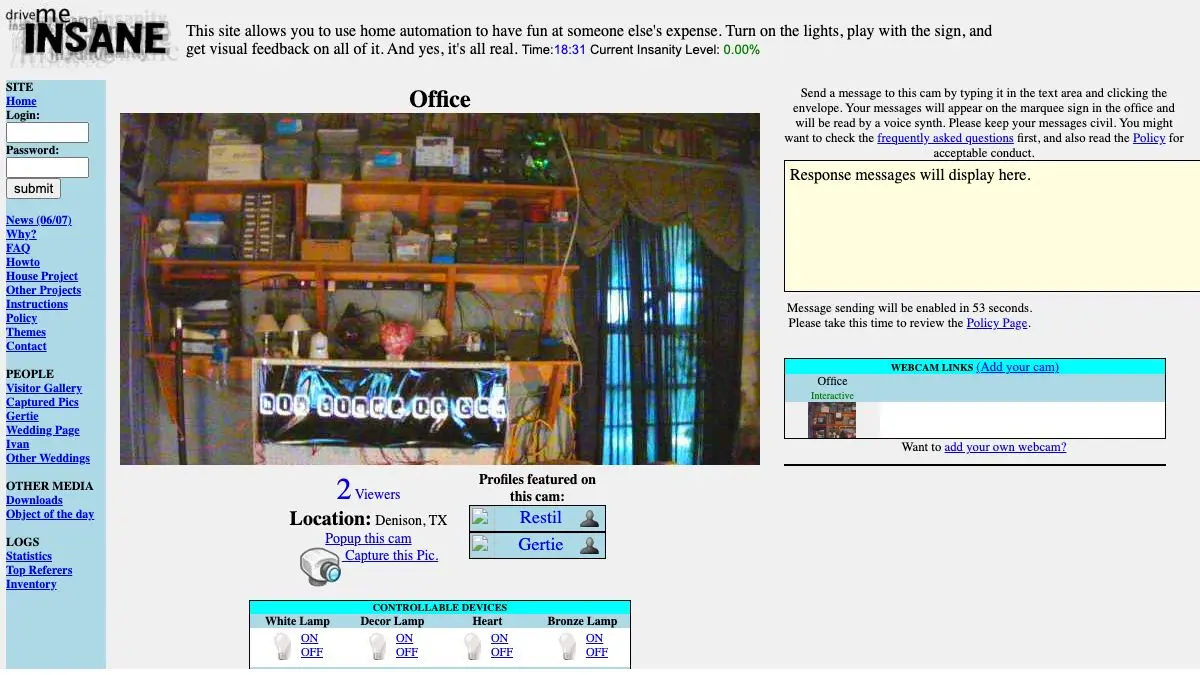
Drive Me Insane is a website where you can turn on a light in someone else’s house and then watch, on a webcam, as the light comes on. Not a simulation. Not a demo. An actual lamp, in an actual room, responding to your click. It has been doing this since 1997, which makes it older than nearly every website you use daily and considerably weirder than all of them.
What is Drive Me Insane?
Paul Mathis read a magazine article about webcams in 1996 and had his first one online by August 1997, pointed at himself. That alone was novel at the time. What made the project last was the next step: wiring the house so that visitors could not just watch, but interfere.
The original mechanism was a parallel-port circuit driving relays, which is exactly as home-brewed as it sounds and worked fine. Later came X10 modules, the consumer home-automation standard of the era, and later still Raspberry Pi boards. The technology stack has been quietly modernized underneath while the premise never changed: strangers on the internet flip switches, and cameras show you it happening.
The site was originally called “Spy on Paul Mathis.” It got its current name in 2002 after a radio DJ made a sarcastic on-air remark about the whole enterprise driving someone insane, and the domain was too good to leave unregistered.
The control set has varied over the decades. Lamps have always been the core. There has been a motorized camera you can pan around a room. There has been a wireless RC car with a camera on it that visitors could drive through the house, which remains one of the more remarkable things anyone has ever put on the open internet. There have been motion sensors logging when doors opened, music playback, and live audio feeds.
Over time it stopped being one house. Other people added their own cameras and controllable hardware, and Drive Me Insane became a small portal: a federation of hobbyists pointing cameras at their own lives and letting the internet press the buttons. The whole thing runs on modest hardware with a monthly transfer cap, serving somewhere in the thousands of visitors a day.
The interface is unreconstructed. Frames. CGI scripts. Theme parameters in the query string. It looks precisely like what it is, a personal site that has been continuously maintained rather than continuously redesigned, and that is a substantial part of the appeal.
What can you do on Drive Me Insane?
- Switch the lights. The founding feature. Toggle a lamp and watch the camera confirm it, with the small delay that proves it is real.
- Watch the live cams. Multiple feeds from multiple locations, updating continuously, hosted on the participants’ own connections.
- Pan the camera. Where a motorized camera is available, you can steer the view around the room rather than accepting the framing you are given.
- Drive the vehicle. The camera-equipped RC car has been one of the site’s signature features, letting remote visitors navigate the house.
- Check the sensor logs. Motion detection with timestamps, so you can see when things happened even when nobody was watching.
- Read the FAQ and the “Why?” page. Genuinely worth it. They explain the hardware, the history and the reasoning in the unhurried voice of someone who has answered these questions for decades.
Tips to get the most out of it
Read the Why page first. It is the best thing on the site. Mathis explains that he does it because it is fun, because it lets him tinker with electronics and code, and because it introduced him to people, including his wife. That context makes everything else land differently.
Expect delay and do not spam the controls. There is a real relay, a real bulb and a real camera refresh between your click and the evidence. Hammering a switch just confuses the queue and the hardware.
Check what is actually live before assuming it is broken. This is a hobby project on residential hardware spanning several households. Cameras go offline, devices get unplugged, people move house. Nothing is guaranteed to be up.
Visit at an odd hour. The controls are more entertaining when the room is dark and you are the only thing changing in it.
Treat it as computing history, not just a toy. This is a working artifact of the 1997 web, when the interesting question was whether you could connect a thing to the internet at all, and the answer was worth building a website around.
Be a decent guest. A person’s actual home is on the other end of the button. The site has survived nearly thirty years partly because most visitors have understood that.
If you like Drive Me Insane, also try…
- Explore.org Live Cams: the professional version, with bears, and some cameras you can also steer.
- LiveATC: live air traffic control audio, another feed of real activity happening right now.
- WebSDR: tune a real radio receiver on the other side of the world from your browser.
- Window Swap: look out of a stranger’s window, minus the ability to interfere with it.
More improbable survivals from the old web in Weird & Wonderful, and more live views of the world in Maps & Exploration.
Frequently asked questions
What is Drive Me Insane?
Drive Me Insane is a website that lets visitors control real devices in a real house and watch the results on live webcams. You can switch lamps on and off, pan a motorized camera around a room, and at times drive a camera-equipped RC car through the building. It has been online since 1997.
Who runs Drive Me Insane?
It is run by Paul Mathis, who set up his first webcam in August 1997. The site was originally called 'Spy on Paul Mathis' and was renamed after a radio DJ made a sarcastic remark about it on air, which is how it ended up on the drivemeinsane.com domain in 2002.
Is Drive Me Insane real or a simulation?
It is real hardware. Over the years the controls have been driven by parallel-port relay circuits, X10 home automation modules and Raspberry Pi boards, with cameras hosted on the participants' own networks. When you flip a switch, an actual lamp in an actual room changes state.
Is Drive Me Insane free to use?
Yes. There is no charge and the controls are open to visitors. It is a personal hobby project that has grown into a small portal of cameras and controllable devices contributed by several people rather than a single household.