// 2026-08-05 · Music & Audio · by Bob Smith
Frequency 2156: Tuning Into Earth's Radio, 130 Years From Now
Frequency 2156 is a collaborative sound project: a fictional radio broadcast from the year 2156, built from clips strangers recorded and sent into the dark.
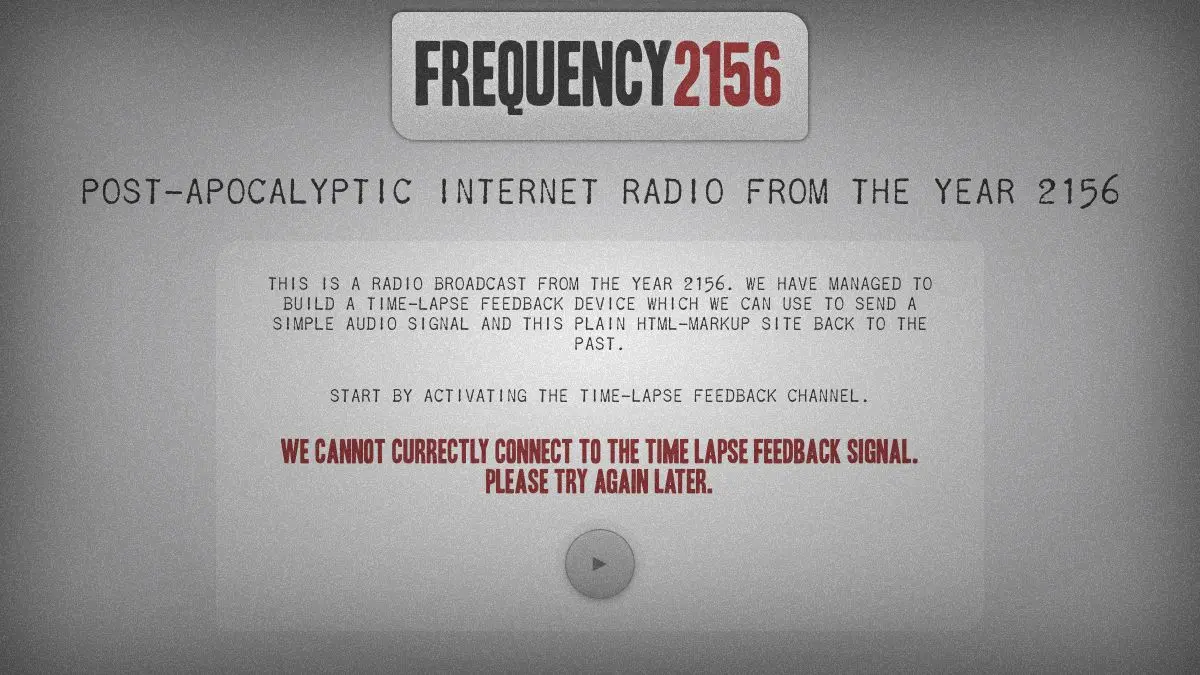
Frequency 2156 asks you to imagine tuning a radio in the year 2156 and picking up whatever Earth is putting out. What you actually hear is a drifting collage of voices, music and noise, contributed by strangers, buried under static and processed until it sounds like it traveled a very long way to reach you.
It is not a station. It is not a playlist. It is a piece of collective sound art disguised as a radio dial, and it is one of the more genuinely haunting things you can leave running in a tab.
What is Frequency 2156?
The conceit is science fiction, and a very old kind. Radio waves leave the planet and keep going. Everything we have broadcast is still out there, expanding outward at the speed of light, which means somewhere in space right now the 1936 Olympics are still arriving at somebody. The idea of listening backward, or forward, across that gulf has been a staple of the genre for a century.
Frequency 2156 turns it into something you can participate in. Rather than an artist producing a fictional future broadcast alone, the project collects contributions from anyone who wants to send something in: a voice, a song fragment, a field recording, a message. Those pieces get processed, layered and mixed into a continuous transmission.
The processing matters as much as the source material. Everything arrives degraded, washed in static and interference, fading in and out the way a distant shortwave signal does. You catch a phrase in a language you do not speak, then it dissolves. Music surfaces for eight seconds and is gone. It is deliberately not clean, because a clean signal would break the illusion entirely.
What emerges from all this is stranger than the sum of its parts. Individually, the contributions are ordinary human noises. Assembled and degraded, they become an artifact: evidence that people were here, arriving out of order and half-destroyed. The emotional register lands somewhere between a time capsule and an unanswered call.
It sits in a small tradition of collaborative internet audio projects, and like most of them, it works because of the crowd rather than in spite of it. Nothing a single artist composed could contain this many accents.
What can you do with Frequency 2156?
- Tune across the dial. Move between frequencies and let the transmission shift under you, the way scanning an actual radio band feels.
- Just leave it running. The single best use. Put it on quietly while you work and let fragments surface at random.
- Listen for the voices. Among the noise there are people saying things, in a lot of languages, and catching one clearly is the small reward the whole piece is built around.
- Send in your own audio. The project is contributor-driven, so you can add something of your own to the transmission.
- Use good headphones. The layering and stereo detail is where a lot of the craft lives, and laptop speakers flatten it into hiss.
- Come back later. As contributions accumulate the broadcast changes, so it is not the same experience twice.
Tips to get the most out of it
Do not listen actively at first. The instinct is to concentrate and try to parse it. That fights the piece. Put it on in the background, let it become ambient, and the moments where something cuts through will land far harder.
Headphones, genuinely. This is one of the few sites where the equipment changes the work. The static is stereo, the layers sit at different depths, and none of that survives a laptop speaker.
Late at night is the right time. Shortwave listening has always been a nocturnal habit, and the piece is clearly built with that in mind. It is a substantially different experience at 2am than at lunchtime.
Record something and send it in. It costs you thirty seconds and puts your voice into a fictional future broadcast alongside strangers from everywhere. Very few art projects let you do that.
Resist the urge to identify everything. The point is not to work out which language that was. Fragments that stay unresolved are doing the work.
Pair it with something visual and slow. It works well underneath anything that does not demand its own audio, which is a large category once you start looking.
If you like Frequency 2156, also try…
- Radio Garden: spin a globe and listen to real live radio stations from anywhere on Earth.
- WebSDR: tune actual software-defined radio receivers around the world, static and all.
- A Soft Murmur: layered ambient soundscapes you can mix yourself.
- Conserve the Sound: an archive of the noises made by machines that no longer exist.
More things worth putting in your ears in Music & Audio, and more oddities in Weird & Wonderful.
Frequently asked questions
What is Frequency 2156?
Frequency 2156 is a collaborative online sound art project presented as a radio transmission from the year 2156. Visitors tune across a dial and hear a continuous stream of audio contributed by people around the world, layered with static, interference and processing so that it sounds like a signal arriving from far away. The framing is that you are listening to what Earth is broadcasting more than a century from now.
Is Frequency 2156 free?
Yes. It runs in a browser with no account and no payment. It is an art project rather than a commercial product, so there is nothing to sign up for and nothing to buy.
Can I contribute my own audio?
The project is built on contributions, and the site provides a way to submit your own recording to be woven into the broadcast. Check the site for the current submission process, since collaborative projects like this open and close contribution windows over time.
What does Frequency 2156 actually sound like?
Something between a shortwave radio at 3am and a half-remembered dream. Fragments of voices in many languages, music, field recordings and noise drift in and out under layers of static, with no clear beginning or end. It is closer to ambient sound art than to a playlist, and it rewards being left running in the background.