// 2026-08-05 · Entertainment & Fun · by Bob Smith
MetaFilter: The Community Weblog That Outlasted the Internet
MetaFilter is a human-moderated community weblog where members post the best things they find online. No algorithm, no engagement metrics, running since 1999.
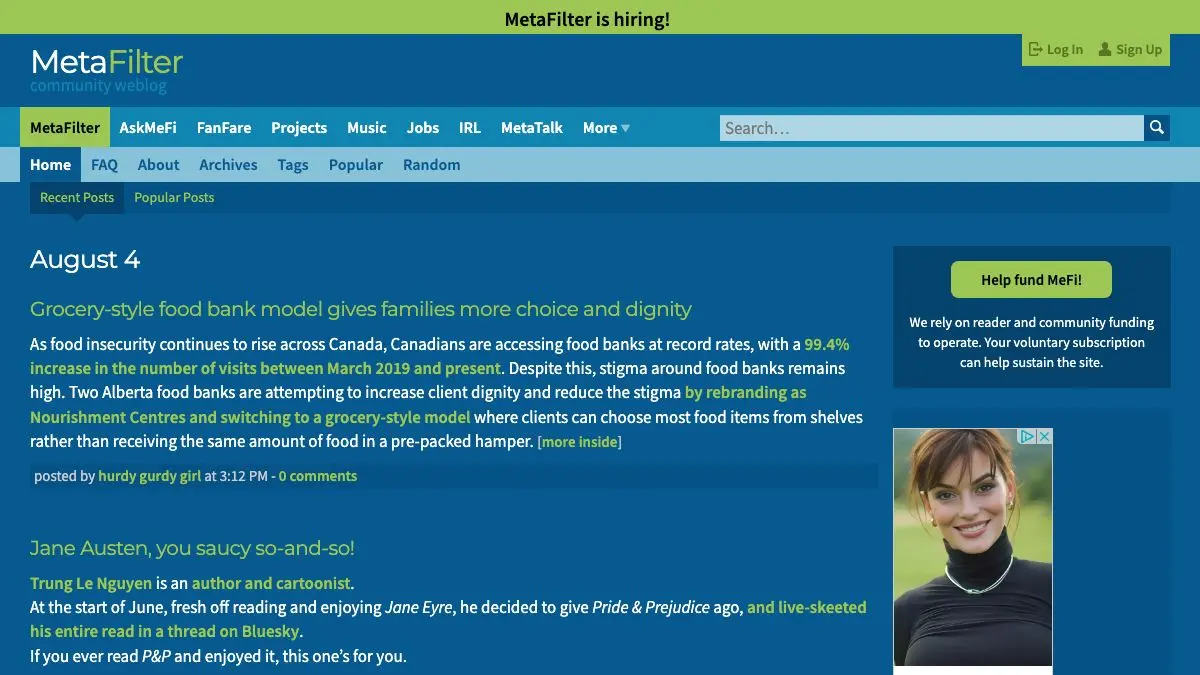
MetaFilter is a website where people post links to good things and then talk about them like adults. That description sounded unremarkable in 1999. It sounds close to science fiction now.
What is MetaFilter?
It was founded in 1999 by Matt Haughey, and it is one of the oldest continuously running communities on the web. The format is simple: a member finds something worth sharing, writes a short post about it with links, and it goes on the front page. Other members discuss it below. That is the whole machine.
What makes it work is everything it refuses to do. There is no upvoting, no karma, no reputation score, no algorithm deciding what you see. Posts appear in chronological order and stay there. There is a hard limit on how often any member can post, which means nobody can flood the site and everyone has to spend their turn on something they actually think is good. Self-linking is banned outright, so nobody is there to promote themselves. And the site is moderated by actual paid humans who read things, which is expensive, unfashionable, and the entire reason the comment sections are readable.
Membership costs a small one-time signup fee, long set at five dollars. It is not a revenue strategy; it is a speed bump. It stops throwaway accounts and makes the act of joining deliberate.
The posts themselves are the old-web ideal: a long-forgotten archive of field recordings, an essay about the collapse of a particular industry, a beautiful thing somebody built for no reason, an obituary for someone you had never heard of who turns out to have been extraordinary. Posts are written, not just dumped, and the good ones read like small pieces of curation with their own voice.
Then there are the subsites. Ask MetaFilter is the crown jewel and for many people the main reason to be there: a question-and-answer section where you can describe a genuinely weird, specific human problem and get thoughtful paragraphs back from strangers. FanFare handles television and film discussion. MetaTalk is where the community argues about itself, publicly, which is its own kind of remarkable. There is also a music section, a projects section for member-made things, and jobs.
Financially it has been through a lot. Ad revenue collapsed after search algorithm changes in the early 2010s, and the site survived by asking members directly for money, which they gave. It is smaller than it was. It is still here, still moderated, still slow on purpose.
What can you do on MetaFilter?
- Read the front page. No account needed. A handful of carefully written posts a day about things nobody else is covering.
- Browse Ask MetaFilter. Search it before you search anything else for problems that involve human judgment rather than facts.
- Ask your own question. Members write real, considered answers, often from direct professional experience.
- Follow the tags. Every post is tagged, and the tags are a decent way into fifteen years of accumulated material on any given subject.
- Read the Best Of. Curated highlights collect the posts and comments the community considers exceptional, which is a good introduction to what the site is capable of.
- Use FanFare. Episode-by-episode discussion threads for shows, without the tone of most television forums.
- Look at Projects. Members show off things they have built, which is a reliable source of small, strange, well-made software and art.
Tips to get the most out of it
Search Ask MetaFilter before you ask anything. Twenty-plus years of questions have been answered there, and the archive is deep. Your problem with the mysterious noise, the difficult relative, or the film you can only remember one scene from has almost certainly been handled already.
Read the comments, genuinely. On most of the internet this is terrible advice. Here the comments are frequently better than the post, and the site is built on the assumption that you will read them.
Do not lurk forever if you plan to join. The five dollars and a week of reading is enough to learn the norms. The community is welcoming to people who have clearly paid attention and impatient with people who have not.
Never link to your own thing. The self-link rule is absolute and enforced. It is the single most important norm on the site and breaking it will end your membership quickly.
Check MetaTalk to understand the place. A community that argues about its own rules in public, in the open, is rare. Reading MetaTalk for an hour tells you more about how MetaFilter works than any FAQ.
Treat it as a slow feed. A few posts a day, no notifications begging for your return. Checking it once a day is the intended experience and the reason it does not feel like the rest of the internet.
If you like MetaFilter, also try…
- Kagi Small Web: a stream of posts from genuinely independent personal websites.
- Wiby: a search engine that only indexes small, hand-made, old-fashioned pages.
- SCP Foundation: another long-running community writing something enormous together with strict shared rules.
- Internet Archive / Wayback Machine: where you go when a MetaFilter post from 2004 links to something that no longer exists.
More corners of the surviving old web in Entertainment & Fun, and the archival end of things sits in Data & Research.
Frequently asked questions
What is MetaFilter?
MetaFilter is a community weblog founded in 1999 where members post links to interesting things they have found online, and other members discuss them in the comments. It is human-moderated rather than algorithmic, has no voting or karma system, and is deliberately slow, with a limit on how often each member can post. It also hosts several subsites, the best known being Ask MetaFilter.
Is MetaFilter free to read?
Reading is completely free and no account is needed. Posting and commenting require membership, which has long carried a small one-time signup fee, historically five dollars, intended to discourage spam and throwaway accounts.
What is Ask MetaFilter?
Ask MetaFilter is the site's question-and-answer subsite, where members ask for advice on anything from plumbing to career decisions to identifying a half-remembered film. Answers come from real people writing at length rather than from a scoring system, which makes it unusually good for messy, human problems that search engines handle badly.
Why does MetaFilter look so old?
Because it largely is, and that is deliberate. The design is text-first, lightly styled, and has changed slowly since the early 2000s. There is no infinite scroll, no recommendation feed and no engagement optimization, which is a substantial part of why the discussion quality has held up.