// 2026-08-05 · Design & Creativity · by Bob Smith
Nikon Small World: The Most Beautiful Photographs Nobody Can See
Nikon Small World is the annual gallery of the world's best microscope photography, decades of winning images from a competition running since 1975, free to browse.
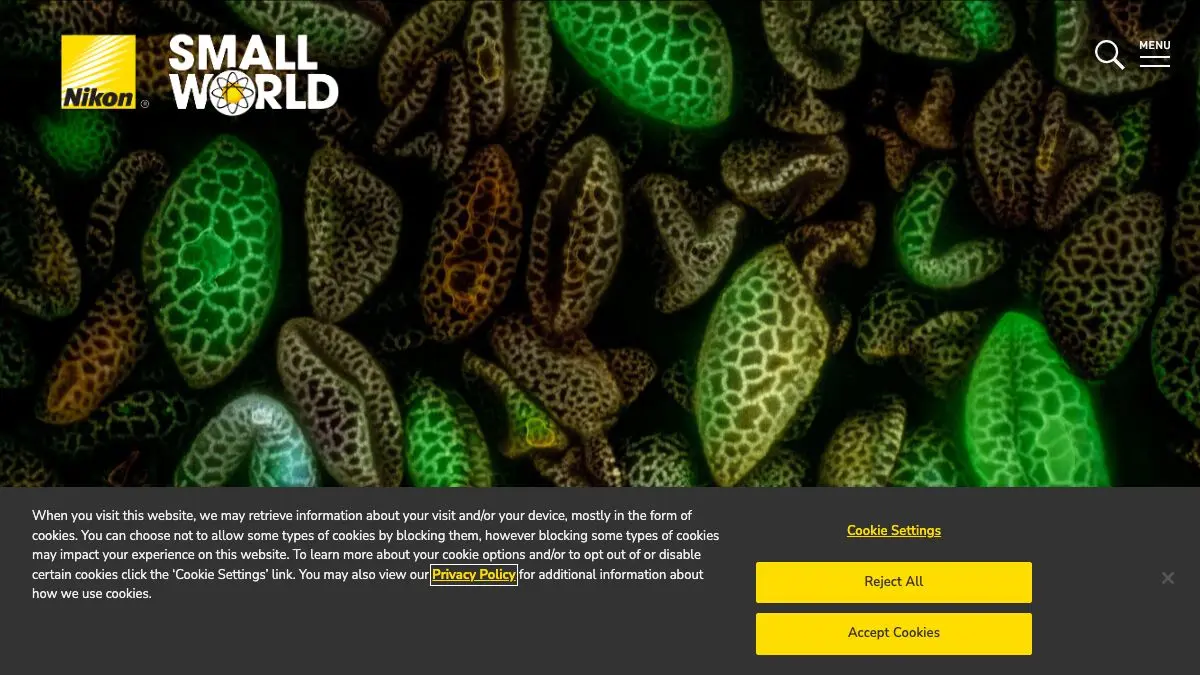
Nikon Small World is an annual competition for photographs taken through a microscope, and the archive is one of the most consistently astonishing image galleries on the internet. A zebrafish embryo’s nervous system glowing in four colors. The compound eye of a horsefly. A single grain of sand at magnification, revealing itself as a pile of broken shells and volcanic glass. A tardigrade, looking as smug as ever.
None of it is retouched into being beautiful. It is beautiful because that is what the world looks like at that scale, and almost nobody ever gets to see it.
What is Nikon Small World?
The competition began in 1975 and has run every year since, which means the archive is now a several-decade record not just of the subjects but of the technology. Early winners are black and white brightfield images of crystals and insect parts. Recent winners are confocal fluorescence composites where a researcher has tagged four different proteins in four different colors inside a living embryo. The whole history of microscopy is visible in the timeline.
The subject range is enormous. Neurons and blood vessels. Insect anatomy in detail no photograph at normal scale could reach. Chemical crystals under polarized light, which produce color so intense they look synthetic. Plant tissue cross-sections. Mold. Ice. Snowflakes. The scales on a butterfly wing. Rodent embryos rendered like stained glass.
What elevates the site above a pretty gallery is the captioning. Each image lists the photographer, their institution, the specimen, the technique and the magnification. Which turns browsing into learning, because after twenty images you start recognizing what darkfield looks like versus polarized light versus confocal fluorescence, and you can predict the technique before reading the caption.
The competition is open to anyone with a light microscope, not just funded researchers, and the winner list has always reflected that. Amateurs have taken top places. Some of the most striking entries come from people who do this in a spare room for fun.
There is also Small World in Motion, the video category, which adds the dimension stills cannot capture: cells dividing, single-celled organisms hunting each other, crystals growing across a slide in seconds.
What can you do on Nikon Small World?
- Browse the winners by year. Every competition back through the decades, each with the full ranked set plus honorable mentions.
- Watch Small World in Motion. The video gallery, which is where the genuinely alien footage lives.
- Read the technical captions. Specimen, technique and magnification on every image, which turns a gallery into a short course.
- Search by subject or technique. Useful if you want to see every polarized light entry, or everything involving insects.
- Follow individual photographers. Certain names recur across years, and their bodies of work are worth tracing.
- Enter the competition. It is open to anyone shooting through a light microscope, with rules and deadlines published annually.
- Grab desktop wallpaper. The images are published at generous resolution and several are frankly better than anything you would buy.
Tips to get the most out of it
Start with an old year, not the newest one. The 1980s and 1990s galleries are shot with vastly less capable equipment and are consequently more impressive per photograph. Then jump to a recent year and the leap in technology hits properly.
Read the magnification figure every time. It is the piece of information that recalibrates you. Something that looks like an aerial photograph of a canyon system turns out to be at 40x, and is a leaf.
Do not skip the honorable mentions. The top twenty get the press coverage, but the long tail of honorable mentions is where the strangest specimens hide, and the judging at that level is essentially a coin flip.
Watch the motion category on a large screen. The video entries are the part most people never find, and they are the part that most reliably makes someone say something out loud.
Learn the four or five main techniques. Brightfield, darkfield, polarized light, fluorescence and confocal. Twenty minutes of reading, and the entire archive becomes legible rather than just pretty.
Use it when you need to remember scale. This is a website that reliably fixes a bad mood by pointing out that the visible world is a thin slice of an extremely busy one.
If you like Nikon Small World, also try…
- Scale of the Universe: zoom from quantum foam to the observable universe and find out exactly where a tardigrade sits.
- OneZoom Tree of Life: an explorable fractal map of every species, including most of the things in these photographs.
- Artvee: high-resolution public domain artwork, including centuries of scientific and botanical illustration.
- Zoomquilt: an infinite painted zoom, for when you want the scale sensation without the science.
More visual overload in Design & Creativity, and more ways to understand the world in Learning & Education.
Frequently asked questions
What is Nikon Small World?
Nikon Small World is an annual photomicrography competition, meaning photographs taken through a light microscope. It has run since 1975 and the site hosts galleries of winning and honorable mention images going back decades, alongside a separate video category called Small World in Motion.
Is Nikon Small World free to browse?
Yes. The full archive of winning images is free to view on the site with no account required. Entering the competition is also free, though it is open to work made with light microscopes and has its own rules and deadlines each year.
Who can enter the Nikon Small World competition?
It is open to anyone photographing through a light microscope, and the entrant list has always mixed professional research scientists with hobbyists and amateur microscopists. Some of the most celebrated winning images have come from people doing it purely as a pastime.
What is Small World in Motion?
Small World in Motion is the video counterpart to the stills competition, covering movies and time-lapse footage shot through a microscope. It captures things stills cannot, such as cell division, organisms moving, and crystals growing in real time.