// 2026-08-05 · Learning & Education · by Bob Smith
OpenStax: Real College Textbooks, Peer-Reviewed and Genuinely Free
OpenStax publishes peer-reviewed college textbooks in math, science, social science and business, free to read online or download, openly licensed and reusable.
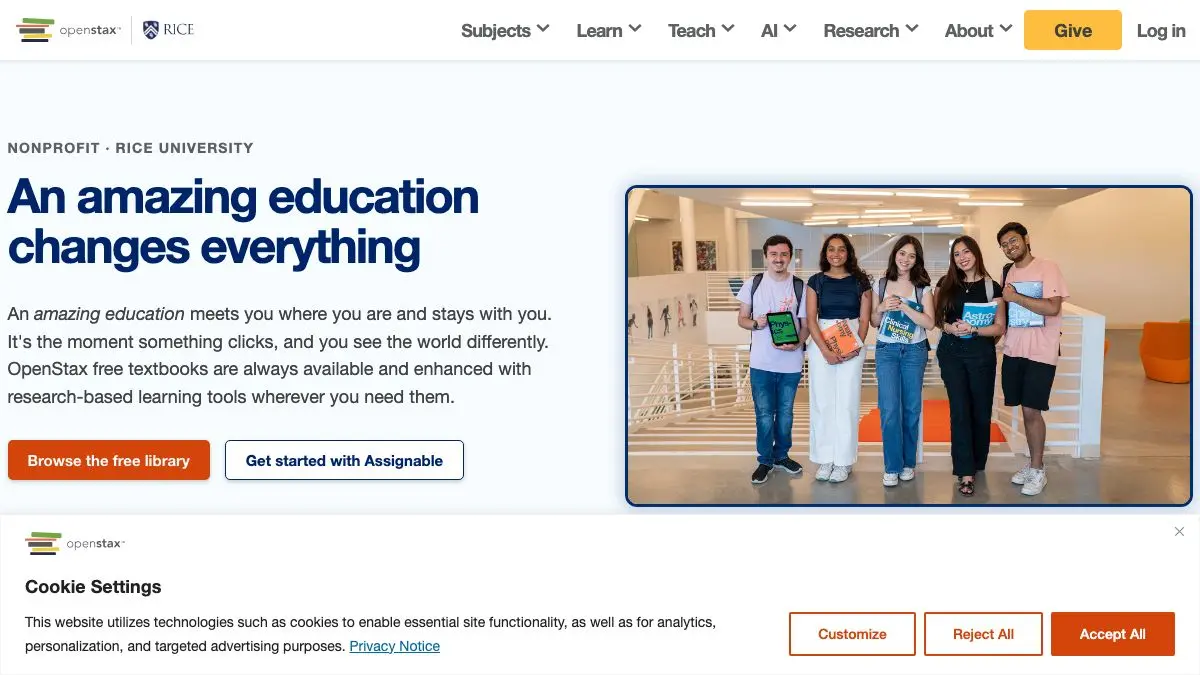
OpenStax publishes college textbooks that cost nothing. Not sample chapters, not a trial, not a rental that expires at the end of the semester. Complete, peer-reviewed textbooks in physics, calculus, biology, chemistry, economics, psychology and dozens of other subjects, free to read online, free to download as a PDF, and openly licensed so you can keep them forever.
Given that the commercial textbook industry spent decades charging students two hundred dollars for an annual reshuffle of the same problem sets, this is a small act of institutional revenge.
What is OpenStax?
It is a nonprofit publishing initiative based at Rice University, launched in 2012 with backing from a group of philanthropic foundations. The founding argument was blunt: introductory college material has been stable for fifty years, the marginal cost of distributing a PDF is zero, and the only thing keeping the price high is a market where the person choosing the book is not the person paying for it.
So OpenStax commissioned real books. Named academic authors, peer review, professional editing and design, revisions between editions. The result reads and looks like a conventional textbook because it is one, produced under a different funding model.
The catalog concentrates on the big enrollment courses, which is where the money was being extracted and where the impact is largest. College Algebra, Calculus, University Physics, Chemistry, Biology, Anatomy and Physiology, Microeconomics, Principles of Management, Introductory Statistics, Psychology, US History, and a growing set of high school and AP-aligned titles.
Everything is released under an open license, which is the part that matters beyond the price. An instructor can reorder chapters, cut what their syllabus does not cover, and add local material, as long as they credit the source. A student can download the file and still have it in ten years. Nobody can revoke access because a subscription lapsed.
Thousands of institutions have adopted the books formally. The site also carries an online reading experience with search, highlighting and notes, and a set of instructor resources behind a verification step.
What can you do with OpenStax?
- Read any book in your browser. The full text, with search, section navigation, figures and exercises, no account needed.
- Download the PDF. Complete books, offline, yours permanently. This is the single most useful button on the site.
- Get a cheap print copy. Softcover editions are sold near production cost for people who genuinely read better on paper.
- Highlight and take notes. A free account adds highlighting and note-taking in the online reader, synced across devices.
- Work the end-of-chapter problems. The books carry the usual exercise sets, review questions and worked examples.
- Adapt the text. The open license permits remixing and redistribution with attribution, which is how instructors build custom versions.
- Request instructor resources. Verified educators can access answer keys, slide decks and assessment material.
- Browse the whole subject list. Math, science, social sciences, humanities, business, nursing and college success titles.
Tips to get the most out of it
Download the PDF on day one. Websites change and links rot. The open license means the copy on your drive is legitimately yours, so take it.
Use it as a shadow textbook. If your course assigned an expensive commercial book, the OpenStax equivalent covers the same standard material in a different voice. Reading the same concept explained twice is one of the most reliable study techniques there is, and here the second explanation is free.
Pair it with a video course. Textbooks are for depth and problems, videos are for first exposure. An OpenStax book alongside a lecture series covers both halves properly.
Check the errata page. OpenStax maintains public errata for each title and folds corrections into new printings. If a worked example is not working, check there before assuming you are wrong.
Do the problems, not just the reading. These books include real exercise sets, and the difference between people who learn calculus and people who have read about calculus is entirely in that section.
Look at the high school titles too. The AP-aligned books are a clean way to fill a gap in your background before attempting the college-level version of a subject.
If you like OpenStax, also try…
- Class Central: find a free online course to go with the free textbook.
- Khan Academy: short, structured video explanations that pair naturally with a chapter you are stuck on.
- The Feynman Lectures on Physics: the inspirational counterpart to a solid, systematic physics text.
- Project Gutenberg: the same free-and-permanent principle applied to sixty thousand books.
More free education worth taking seriously in Learning & Education.
Frequently asked questions
What is OpenStax?
OpenStax is a nonprofit publisher based at Rice University that produces free, peer-reviewed college textbooks. Its catalog covers introductory courses in mathematics, physics, chemistry, biology, economics, psychology, sociology, business and more. The books are written and reviewed by academics and are used as the assigned text in thousands of courses.
Are OpenStax textbooks really free?
Yes. Every book can be read online or downloaded as a PDF at no cost, with no account required. The books are released under an open license that allows you to keep, copy, adapt and redistribute them with attribution. OpenStax also sells low-cost printed copies for people who prefer paper, and it is funded largely by philanthropic grants.
Are OpenStax books as good as commercial textbooks?
They go through the same kind of writing, review and revision process as commercial introductory textbooks, with named academic authors and peer reviewers listed in each book. Many universities have formally adopted them for introductory courses. They are strongest in the large first- and second-year subjects and thinner in specialized upper-level areas.
Can teachers use OpenStax material in their own courses?
Yes, and that is the point of the open license. Instructors can assign a book, remix chapters, reorder material or adapt the text for their own syllabus as long as they credit OpenStax. Verified instructors can also request supplementary resources such as answer keys, slides and test banks.