// 2026-08-05 · Maps & Exploration · by Bob Smith
Oyster: Hotel Photos Nobody Was Allowed to Retouch
Oyster sends its own reviewers to hotels, photographs everything unedited, and publishes the results next to the marketing shots the hotel would prefer you saw.
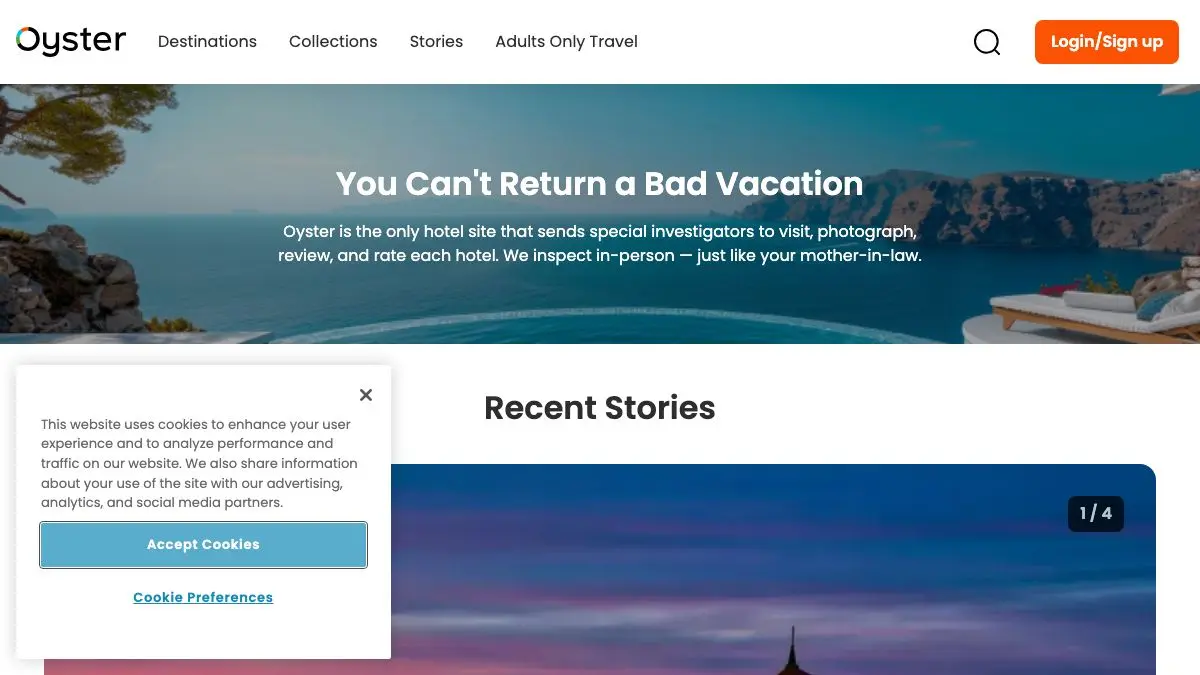
Oyster is a hotel review site with an unusual policy: it sends its own people to the hotel, has them photograph it without staging, and publishes those pictures alongside the ones the hotel’s marketing department produced. The contrast is frequently devastating and always instructive.
Most travel research is an exercise in trying to work out what is being hidden. Oyster’s entire premise is to just show you.
What is Oyster?
Hotel photography is a specialist craft dedicated to deception. Not lying exactly, but a highly refined selective truth. The ultra-wide lens that turns a cramped room into a suite. The crop that ends precisely where the parking structure begins. The infinity-pool shot taken at the one hour of the one day when nobody is in it. The “ocean view” photographed from a balcony you cannot book, on a floor you will not be on.
Oyster launched in 2009 to counter all of it with the simplest possible method: go there, take photos, publish them.
Reviewers visit properties in person and shoot everything, the good and the depressing. Rooms in normal daylight, actual bathrooms, the lobby with real people in it, the pool as it looks on a regular afternoon. Then they write it up, covering the things that determine whether a stay works: noise, walkability, whether the beach is really a beach, what condition the furniture is in, who the place is actually suited to.
The signature feature is Photo Fakeouts, which puts the hotel’s official image directly beside the reviewer’s photo of the same spot. It is the clearest single illustration anyone has produced of how travel marketing works, and it is oddly addictive to browse even when you have no trip planned.
Oyster was acquired by TripAdvisor some years ago and has changed shape over time, with an increasing focus on articles and roundups alongside the property reviews. The archive of inspected properties and their unretouched photo galleries remains the reason to go.
The obvious limitation: hand-inspecting hotels does not scale. Coverage skews toward major tourist destinations and larger properties, and plenty of places simply have not been visited. Oyster is a supplement to your research, not a replacement for it.
What can you do with Oyster?
- Look at unedited photos of the actual rooms. Shot by someone with no interest in making the place look better than it is.
- Compare marketing shots to reality. Photo Fakeouts, side by side. Start here even if you never book anything.
- Read a professional inspection. Written by someone who was physically in the building and looked at the things you would look at.
- Filter by what matters to you. Family suitability, romance, budget, location quality, and similar categories, applied consistently across properties rather than left to individual reviewer whim.
- Check the neighborhood assessment. Reviews cover what surrounds the hotel, which is frequently the difference between a good stay and a bad one and is invisible in any photo.
- Browse destination roundups. Curated lists of properties in a given city or region, drawn from the inspected set.
Tips to get the most out of it
Go straight to the photo gallery first. The written review is useful, but the unedited pictures tell you in thirty seconds what a paragraph takes longer to convey. Look at the bathroom photos in particular; they age worst and are most revealing.
Use Oyster to eliminate, not to choose. Its strength is catching the property that looked perfect on the booking site and clearly is not. Shortlist elsewhere, then check the shortlist here.
Check the review date. Hotels get renovated and hotels decline. An inspection from several years ago describes a building that may no longer exist in that form.
Read the “who it is for” framing. A hotel that a review calls perfect for couples seeking quiet is a specific warning if you are traveling with a four-year-old. The category assessments are more useful than the overall verdict.
Look at what is around the pool. Reviewers photograph context, not just the amenity. The gap between “pool” and “pool overlooking a six-lane road” is where most disappointment lives.
Compare prices somewhere else before booking. The site monetizes through booking links, which is fine and normal, but the rate shown is not automatically the best available.
If you like Oyster, also try…
- Atlas Obscura: plan what you will actually do once you have a hotel that is not a lie.
- Hoodmaps: crowd-labeled city maps telling you what each neighborhood is really like.
- Random Street View: another way to see what a place looks like when nobody is arranging the shot.
- Komoot: route planning for the part of the trip that happens outdoors.
More travel-adjacent rabbit holes in Maps & Exploration.
Frequently asked questions
What is Oyster?
Oyster is a hotel review site built around in-person inspections rather than user submissions. Reviewers visit properties, photograph them without staging or retouching, and write up what they found. The site is known for its Photo Fakeouts feature, which places a hotel's own promotional image next to the reviewer's photo of the same spot.
Is Oyster free to use?
Yes, browsing reviews and photos is free and does not require an account. The site earns revenue through booking links and advertising, which is the standard model for travel sites, so it is worth comparing prices elsewhere before booking.
How is Oyster different from TripAdvisor?
TripAdvisor is built on user-submitted reviews at enormous scale. Oyster covers far fewer hotels but visits each one with its own reviewers and photographers, so the coverage is deeper and more consistent. The tradeoff is breadth: if a hotel has not been visited, it is not on there in any meaningful way.
What are Photo Fakeouts?
Photo Fakeouts is Oyster's side-by-side comparison of a hotel's official marketing photograph and the reviewer's unedited photo of the same view. It exposes the standard tricks of hotel photography: extreme wide-angle lenses, careful cropping that hides a highway, and beach shots taken from the one angle where the construction site is out of frame.