// 2026-08-05 · Weird & Wonderful · by Bob Smith
Plane Crash Info: Last Words, an Archive of Final Cockpit Transcripts
Plane Crash Info collects the final recorded words from aviation accidents, drawn from official cockpit voice recorder transcripts. Sobering, factual and unsensational.
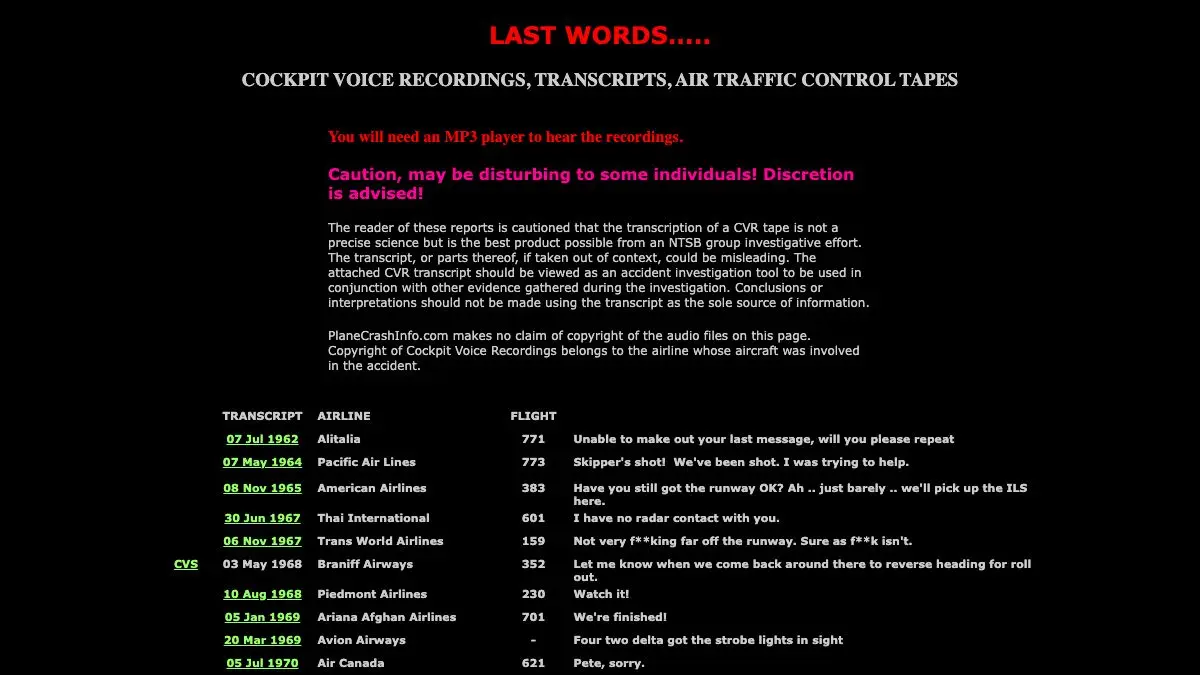
Plane Crash Info: Last Words is a plain HTML page, unstyled and unadorned, listing the final recorded words spoken in the cockpits of aircraft that did not land. Date, airline, aircraft type, and then a few lines of transcript.
It is not a gore site and it is not trying to shock you. It is a page of primary source material, presented flatly, and it is one of the most affecting things on the internet precisely because nobody has tried to make it affecting.
What is Plane Crash Info?
The Last Words page is one corner of PlaneCrashInfo.com, a long-running independent aviation accident reference that has been maintained by one person for decades. The broader site holds an accident database stretching back to the earliest years of commercial flight, along with breakdowns of accident causes, statistics on fatality rates, survivability data, and safety records by operator. It looks like it was built in the late 1990s because it was, and it has never been redesigned into something worse.
The material comes from the public record. Aviation is unusual among industries in that its failures are investigated openly and published in full. Agencies like the US National Transportation Safety Board, and their counterparts worldwide, release detailed accident reports, and those reports routinely include transcripts of the cockpit voice recorder. In the United States the audio itself is protected by law and never released publicly, but the written transcript becomes part of the docket.
That openness exists for a reason. Nearly every safety feature in modern aviation is written in the aftermath of a specific accident. Crew resource management, terrain awareness systems, checklist design, sterile cockpit rules, all of it traces back to investigations where somebody read a transcript and understood what had gone wrong in that cockpit.
What the Last Words page does is strip those transcripts back to their final seconds and place them next to each other. The effect of reading fifty of them in a row is not what you expect. There is very little drama. Mostly there is procedure, then confusion, then a short, ordinary human reaction. Pilots calling out what they see. Someone saying a name. Somebody, very often, still working the problem.
It is worth saying plainly: this is a page about people who died. It carries no music, no imagery and no editorializing, and that restraint is what makes it defensible rather than ghoulish. Read it in that spirit.
What can you find on Plane Crash Info?
- The Last Words archive. Final cockpit transcript excerpts, listed chronologically with the accident details attached.
- The accident database. A searchable record of aviation accidents going back to the early decades of powered flight.
- Cause breakdowns. Statistics on what actually brings aircraft down, categorized by pilot error, mechanical failure, weather, sabotage and other factors.
- Safety statistics. Fatality rates, survivability figures, and the odds calculations that people reach for before a flight.
- Operator records. Accident histories organized by airline, useful context for anyone researching a particular carrier.
- Historical detail. Entries covering the accidents that produced specific regulatory changes, which is where the site becomes genuinely educational.
Tips to get the most out of it
Read the accident report alongside it. The excerpt on its own is a fragment. The NTSB or equivalent report explains what the crew knew, what they did not know, and why the sequence unfolded as it did. The transcript makes far more sense, and is far less bleak, with the investigation attached.
Understand the vocabulary before you judge. A lot of what sounds like panic is standard callout phraseology, and a lot of what sounds calm is a crew running procedures under extreme load. Knowing the difference changes how the transcripts read entirely.
Notice how often the crew is still flying the aircraft. The dominant impression across the archive is not terror. It is people continuing to work the problem to the last second. That is the detail most readers take away.
Do not read it in one sitting. It is a page you can scroll through in twenty minutes, and doing so is a genuinely heavy experience. Dip in rather than consuming it whole.
Treat the safety statistics as the counterweight. The rest of the site documents how extraordinarily safe commercial aviation has become, and that is the direct consequence of the investigations these transcripts come from. Reading the Last Words page without that context gives you a badly distorted picture.
Skip it if you are a nervous flyer. This is not a caveat, it is a recommendation. There is nothing here that will help you and quite a lot that will not.
If you like Plane Crash Info, also try…
- LiveATC: live air traffic control audio, the same radio discipline in ordinary, uneventful use.
- Flightradar24: every aircraft currently in the sky, tracked live on a map.
- Futility Closet: a long-running archive of historical curiosities, oddities and forgotten disasters.
- Internet Archive / Wayback Machine: the broader project of keeping primary sources available to anyone who wants them.
More of the internet’s stranger archives in Weird & Wonderful, and the harder numbers in Data & Research.
Frequently asked questions
What is the Plane Crash Info Last Words page?
It is a page on PlaneCrashInfo.com that collects short excerpts of the final recorded words from the cockpit voice recorders of fatal aviation accidents, arranged chronologically with the date, operator and aircraft type. It is part of a much larger aviation accident database that also covers causes, statistics and safety records.
Are the cockpit transcripts real?
Yes. The excerpts are drawn from official accident investigation reports published by bodies such as the US National Transportation Safety Board and equivalent agencies elsewhere. In the United States the audio itself is not released to the public by law, but written transcripts are published as part of the accident docket.
Is Plane Crash Info free to use?
Yes. The site is free, has no account system and has been maintained as a personal reference project for many years. It is plainly formatted and carries very little beyond the data itself.
Why do people read cockpit voice recorder transcripts?
Aviation safety improves through public investigation, and the transcripts are a core part of that public record. Pilots, investigators, researchers and journalists use them to understand how accidents unfolded. Casual readers are usually drawn by the same instinct that makes any first-hand account of a disaster compelling, which is worth being aware of before you start reading.
Visit Plane Crash Info: Last Words →
← All posts · Browse the directory