// 2026-08-05 · Learning & Education · by Bob Smith
The Diary of Samuel Pepys: A 17th-Century Life, Published One Day at a Time
The Diary of Samuel Pepys publishes the 1660s diary as a daily blog, annotated by readers, so you follow plague, fire and gossip at the pace Pepys lived it.
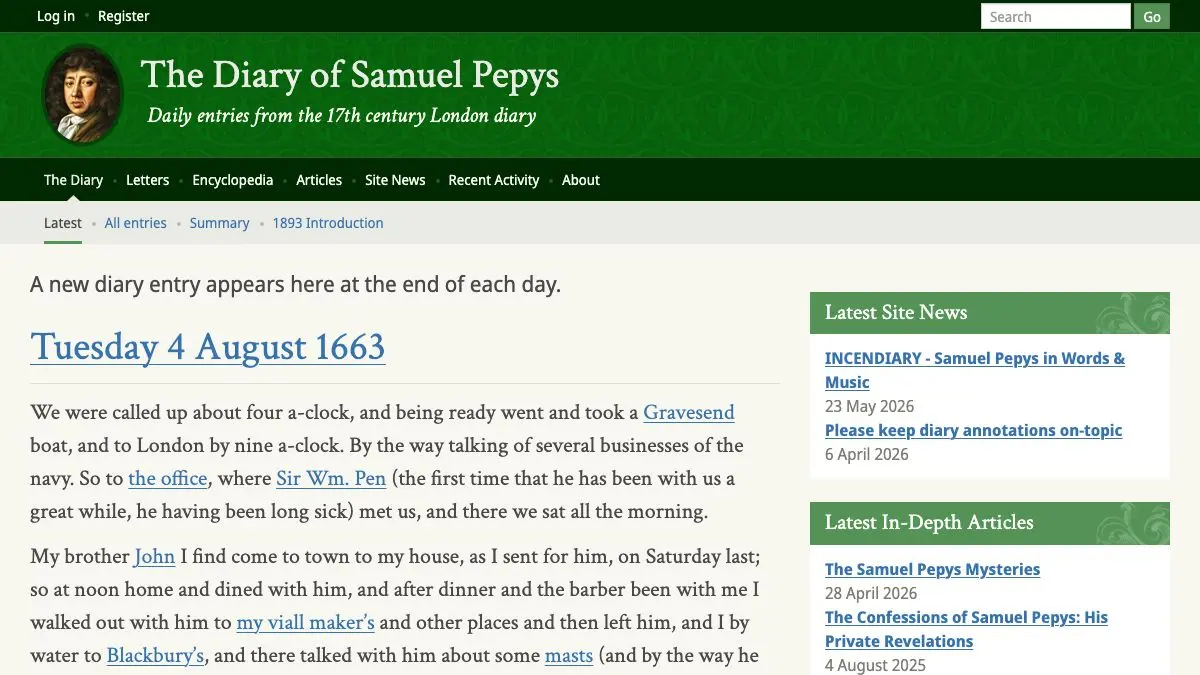
The Diary of Samuel Pepys publishes a 350-year-old diary at the speed it was written: one entry per day, on the matching date. Today you get what Pepys wrote on this day in the 1660s. Tomorrow you get tomorrow’s. It is the slowest possible way to read a book and, for this particular book, easily the best.
What is The Diary of Samuel Pepys?
Samuel Pepys was a naval administrator in Restoration London who kept a private diary from 1660 to 1669, written in shorthand and never meant for anyone else. That privacy is why it survives as one of the great documents of ordinary life: he records what he ate, what things cost, which colleagues he despised, when he lied to his wife, and how frightened he was, with no eye on posterity at all.
He also happened to live through the coronation of Charles II, the Great Plague of 1665, the Great Fire of London in 1666, and a Dutch fleet sailing up the Medway. The diary contains some of the most vivid eyewitness accounts of all of them, wedged between complaints about servants and notes on his new periwig.
In 2003 Phil Gyford started publishing it as a daily blog, with each entry appearing exactly 343 years after it was written. The project ran the full nine and a half years to the diary’s end in May 1669, and has since begun again, so new readers can join a fresh cycle rather than being handed an archive.
The annotations are what make it more than a text dump. Readers and editors have spent two decades adding notes to entries, explaining who a name belongs to, what a coin was worth, what a dish was, what a piece of forgotten slang meant. The result is a distributed commentary of a scale no single editor would ever produce, plus an encyclopedia of the people, places, ships and terms that recur.
The daily format does something a book cannot. Pepys did not know about the plague in 1664, or that the fire would take the city in 1666, and reading forward at one entry a day means you do not either. Foreboding accumulates. When September 1666 arrives, it genuinely lands.
What can you do with The Diary of Samuel Pepys?
- Read today’s entry. The front page shows whatever Pepys wrote on this date, usually two minutes of reading.
- Subscribe by email or feed. Have the entry arrive daily, which is the intended way to experience the whole thing.
- Read the annotations. Every entry carries reader notes explaining context, and they are frequently more interesting than the entry itself.
- Browse the encyclopedia. Entries for people, places, ships, food and terminology, cross-linked from the diary text.
- Follow a person through the years. Each recurring figure has a page listing every entry they appear in, which turns the diary into a set of biographies.
- Jump to the famous days. The plague summer of 1665 and the fire in September 1666 are all there, fully annotated, if you cannot wait.
- Add your own annotation. Registered readers can contribute notes, which is how the commentary got this deep in the first place.
Tips to get the most out of it
Subscribe and do not binge. The daily drip is the entire design. Reading three years in a weekend converts a genuinely strange experience into a fairly long book.
Always open the annotations. A line about a man you have never heard of turns into a small drama once a reader explains who he was and what he was doing there. This is where the site earns its reputation.
Do not try to understand every word. Pepys writes in period English with period slang and a lot of casual name-dropping. Let the fog sit. Recurring people and places resolve themselves within a few weeks of reading.
Use the encyclopedia when a name sticks. When you notice you keep seeing the same colleague, look him up. Following one figure through the entries is the single best thing the site’s structure enables.
Read the entries about money. Pepys is obsessive about his net worth and completely unembarrassed about it, and those passages are a better window on 1660s economics than most history books.
Brace for the unflattering parts. He is petty, vain, and frequently behaves appallingly toward women, and he writes it all down because nobody was ever supposed to read it. That honesty is exactly why the diary is valuable, but it is not a comfortable read.
If you like The Diary of Samuel Pepys, also try…
- Project Gutenberg: free public domain texts, including plenty from the same period.
- Internet Archive / Wayback Machine: the modern equivalent of preserving what nobody thought to keep.
- OldMapsOnline: find historical maps of the London Pepys was walking around.
- Futility Closet: short, well-sourced historical curiosities in the same daily-habit shape.
More history worth living inside in Learning & Education, and more archives in Data & Research.
Frequently asked questions
What is The Diary of Samuel Pepys website?
It is a site by Phil Gyford that publishes the diary of the English naval administrator Samuel Pepys one entry per day, matching the date he wrote it 350-odd years earlier. Each entry is annotated by readers and editors with explanations of people, places, slang and events, and the site includes an encyclopedia of recurring subjects. It began in 2003 and has run through the full diary more than once.
Is the Pepys diary site free?
Yes, the entire diary and all annotations are free to read with no account. You can also follow it by email or feed so a new entry arrives each day, which is how most regular readers use it.
Who was Samuel Pepys?
Samuel Pepys was an English naval administrator and Member of Parliament who kept a private diary from 1660 to 1669. He wrote it in shorthand and never intended it for publication, which is why it is unusually candid about money, ambition, marriage and his own bad behavior. He was also an eyewitness to the Great Plague of 1665 and the Great Fire of London in 1666.
Why read the diary daily instead of as a book?
Reading one entry a day reproduces the experience of not knowing what happens next. Pepys did not know the plague was coming or that London would burn, and neither do you until the entries arrive. It also breaks a very long book into pieces of two minutes each, which is why people stay with it for years.
Visit The Diary of Samuel Pepys →
← All posts · Browse the directory