// 2026-08-05 · Music & Audio · by Bob Smith
BBC Sound Effects Archive: 16,000 Sounds From a Century of Broadcasting
The BBC put over 16,000 sound effects from its archive online, searchable and free to download for personal, educational and research use. Steam trains included.
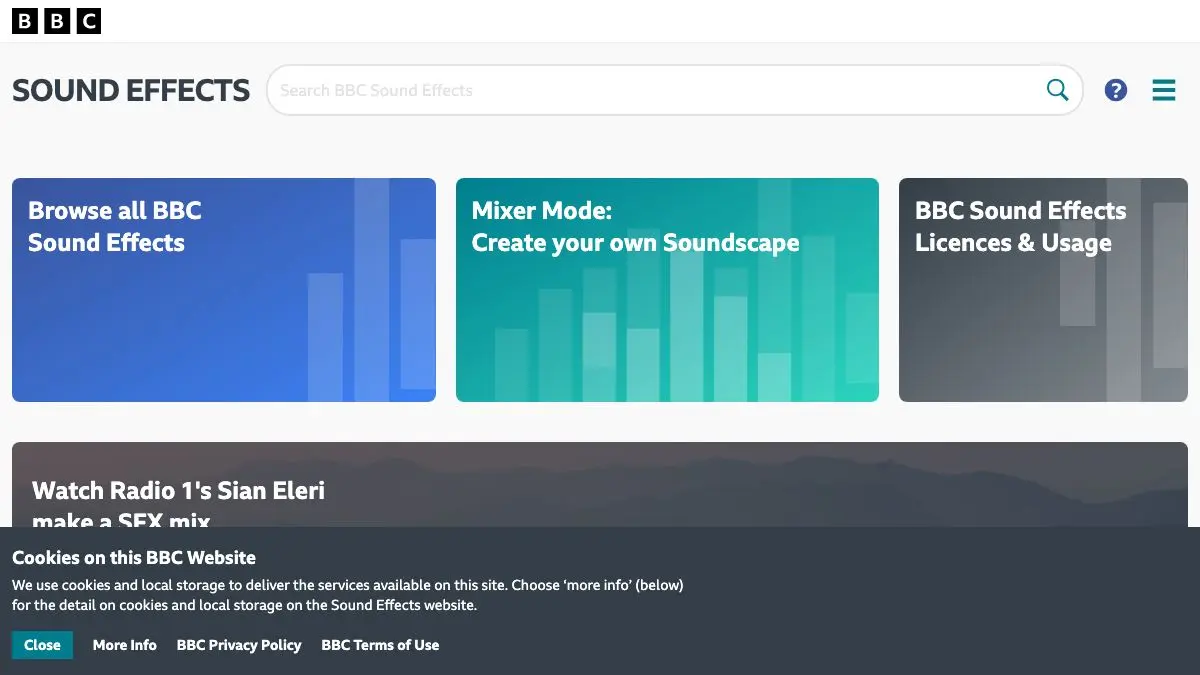
BBC Sound Effects Archive is what happens when one of the world’s oldest broadcasters opens the cupboard where it keeps the noises. Over 16,000 recordings, gathered across decades of radio and television production, put online in a searchable database and made free to download for personal, educational and research use. Doors, thunderstorms, Victorian machinery, a specific species of frog, the interior of a 1970s bus. It is all in there, and it is all playable in your browser right now.
What is the BBC Sound Effects Archive?
Radio drama is built out of sound effects, and the BBC has been making radio drama since the 1920s. Over that time it accumulated an enormous library, recorded by staff, catalogued by hand, stored first on discs and tape and eventually in digital form. For most of its life this collection existed to serve productions, not the public.
The archive site, part of the BBC’s Rewind project, published a large chunk of it. The scale is the first thing you notice, and the specificity is the second. This is not a generic effects pack. Entries are described with the flat, precise language of a broadcast catalog: the make of the vehicle, the county the birdsong was recorded in, whether the crowd is applauding or booing, how many people are in the room.
That precision comes from the fact that these were working files. Someone needed exactly the sound of a particular kind of latch on a particular kind of door, and someone else went and recorded it. Multiply that by ninety years of programming and you get a library that documents the sonic texture of the twentieth century almost by accident.
Some of the material is genuinely irreplaceable. Machinery that has been scrapped. Industrial processes that no longer happen. Vehicles, tools, and public spaces that sound nothing like they do today. Whatever you came for, you will end up listening to a steam locomotive shunting in a goods yard.
The interface is straightforward: search or browse by category, preview clips inline, download what you want as WAV. There is also a mixer that lets you stack several sounds and adjust their levels, which is a surprisingly good way to build an ambience without opening a DAW.
The one thing to be careful about is licensing. The material is offered under the BBC’s RemArc licence, which covers personal, educational and research use. It does not cover commercial projects. Read the terms before you put any of it into something you plan to sell.
What can you do with the BBC Sound Effects Archive?
- Search 16,000+ effects. Type what you need, from “typewriter” to “seagull” to “hydraulic press,” and preview results without leaving the page.
- Browse by category. Nature, transport, machines, crowds, household, atmospheres. Good for wandering when you do not know what you are looking for.
- Preview before downloading. Every clip streams in the browser, so you can audition a dozen doors in a minute.
- Download uncompressed WAVs. No lossy compression, so the files hold up to editing, pitching and layering.
- Layer sounds in the mixer. Combine several effects and balance them to build a scene entirely on the site.
- Score a student film or podcast. Educational and personal projects are exactly what the licence is for.
- Mine it for sampling and sound design. Old machinery and unusual textures are raw material that no synthesizer preset will give you.
- Listen to vanished technology. Some of these machines no longer exist anywhere, which makes the archive quietly historical as well as useful.
Tips to get the most out of it
Search by the object, not the mood. The catalog was written by archivists, not by a stock audio marketing team. “Tension” gets you nothing. “Clock ticking” gets you dozens.
Read the descriptions properly. They often contain the detail that decides between two similar clips: the recording location, the era, whether it was captured indoors, how many takes are in the file.
Check the duration before downloading. Some entries are long atmospheric recordings rather than short one-shots. That is often what you want for a background bed, and a nuisance if you needed a single impact.
Use the mixer as a sketchpad. Layering three sounds on the site takes ten seconds and tells you immediately whether the combination reads as a place. Then download only the files that survived.
Take the licence seriously. Personal, educational and research use is generous, but it is not the same as public domain. If money is involved anywhere in your project, check the terms rather than assuming.
Search adjacent words. British archival cataloging uses vocabulary you may not reach for. Try “lorry” as well as “truck,” “tap” as well as “faucet,” “railway” as well as “train.”
If you like the BBC Sound Effects Archive, also try…
- Conserve the Sound: an audio museum of obsolete objects, recorded and photographed with real care.
- Internet Archive / Wayback Machine: the other great free repository of things nobody else bothered to keep.
- A Soft Murmur: layered ambient sound, but built for concentration rather than production.
- Chrome Music Lab: once you have the sounds, somewhere playful to experiment with what they do.
Plenty more listening in Music & Audio, and more free raw material in Data & Research.
Frequently asked questions
What is the BBC Sound Effects Archive?
It is a public website where the BBC has published more than 16,000 sound effects drawn from its own archive, covering decades of radio and television production. Recordings range from ordinary household noises to steam locomotives, wildlife, crowds, weather and machinery that no longer exists. Everything is searchable and streams in the browser before you download it.
Are the BBC sound effects free to use?
They are free to download and use for personal, educational and research purposes under the BBC's RemArc licence. Commercial use is not covered by that licence, so if you are making something you intend to sell or monetize, you need to look elsewhere or seek separate permission. Always read the licence terms on the site before publishing anything.
What format are the downloads?
Effects download as uncompressed WAV files, which is what you want for editing since there is no lossy compression to degrade further. File lengths vary enormously, from a one-second door latch to atmospheres running many minutes. You can preview any clip in the browser before committing to a download.
Can I mix sounds together on the site?
Yes. The site includes a mixer that lets you layer several effects at once and balance their levels, so you can build an ambience, rain over traffic over a distant crowd, without opening any audio software. It is a quick way to test whether a combination works before you download the individual files.
Visit BBC Sound Effects Archive →
← All posts · Browse the directory