// 2026-07-27 · Learning & Education · by Bob Smith
BetterExplained: Math That Finally Makes Sense
BetterExplained teaches math with intuition and analogies first, formulas second. Free articles on calculus, imaginary numbers, Bayes, and Fourier transforms.
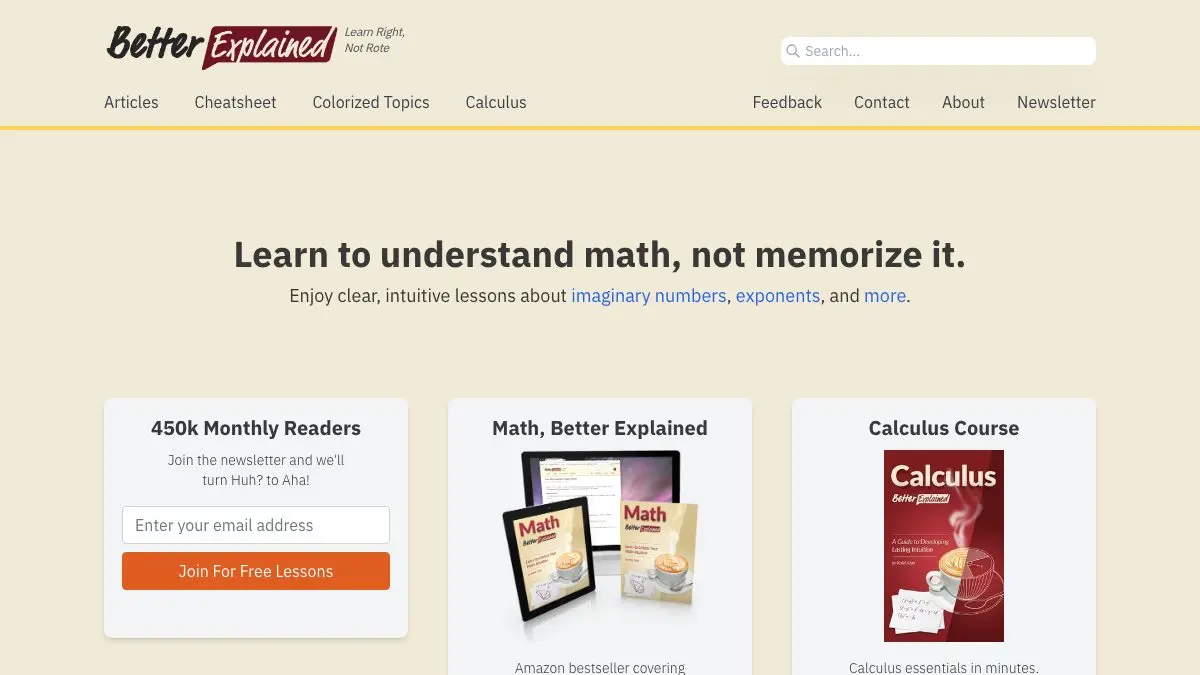
BetterExplained is a math site built on one stubborn idea: you should understand a concept before you’re handed the formula. Instead of opening with notation, every article opens with an analogy, a picture, a story, something you can hold in your head, and only then earns the right to write down symbols. If math ever felt like a series of rules you memorized and resented, this is the site that fixes it.
What is BetterExplained?
Most math teaching goes in the wrong order. It gives you the polished, compressed result that took mathematicians centuries to find, then acts surprised when you can’t reconstruct the reasoning. BetterExplained flips that. The articles here start where the idea started: what problem was somebody actually trying to solve, and what does the answer feel like?
The classic example is imaginary numbers. Told that i is the square root of -1, most people nod and quietly panic. Told that i is a rotation, a way of turning, not a weird kind of counting, the whole thing snaps into focus. That’s the move, repeated across the entire site. Exponentials become growth you can picture. Radians become a measurement taken from the mover’s point of view. The Fourier transform becomes a way of asking “what smoothies went into this recipe?”
It’s written in a friendly, first-person voice by someone clearly working through his own confusion in public, which is exactly why it lands.
What can you learn there?
The archive is broad and it keeps going deeper than you expect:
- Arithmetic and numbers: mental math, logarithms, modular arithmetic, and why negative numbers took so long to be accepted.
- Algebra, geometry, and trig: the Pythagorean theorem from several angles, quadratics, sine waves, radians, complex numbers.
- Statistics and probability: Bayes’ theorem, the birthday paradox, the Monty Hall problem, all explained without the usual hand-waving.
- A free calculus course: around fifteen lessons that build derivatives and integrals from intuition first, plus supplementary articles.
- Vector calculus: gradient, divergence, curl, flux, dot and cross products, each with a physical picture attached.
- Engineering and university math: linear algebra, convolution, and the Fourier transform, the article many engineers wish they’d read first.
- Programming and computing: Git, debugging, binary formats, Unicode, HTTP caching. Same philosophy, different subject.
Tips to get the most out of it
- Start with the topic you hated most. Seriously. Pick the thing that broke you in school, e, imaginary numbers, integrals, and read that article. The site is at its best on exactly those concepts.
- Read the analogy twice before scrolling on. The formulas later in each article only click if the mental picture is solid. Rushing past the story to find the equation defeats the entire method.
- Use the cheatsheet as a map. There’s a summary view of the concepts that works well for figuring out what to read next, or for a fast refresher before an exam or an interview.
- Take the calculus course in order. The lessons build. It’s tempting to jump to the topic you need, but the early framing is what makes the later lessons feel obvious.
- Explain it back to someone. These articles are written to be retold. If you can hand the analogy to a friend and watch them get it, you actually learned it.
If you like BetterExplained, also try…
- Bartosz Ciechanowski: the same intuition-first spirit applied to physics and engineering, with interactive simulations you can drag.
- Khan Academy: when you want structured practice and problem sets to go with the understanding.
- Wolfram Alpha: for checking your work, plotting a function, and seeing the steps.
There’s a whole shelf of this stuff on the Learning & Education page. But if math has ever made you feel stupid, start at BetterExplained. It won’t.
Frequently asked questions
What is BetterExplained?
BetterExplained is a math site that leads with intuition instead of notation. Each article explains a concept, imaginary numbers, e, calculus, Bayes' theorem, the Fourier transform, with analogies, diagrams, and plain language before any formula appears. It is aimed at anyone who passed a math class without ever understanding what they were doing.
Is BetterExplained free?
Yes. The articles and the multi-lesson calculus course are free to read on the site, with no account required. There is an optional paid ebook for people who want the material packaged up, but nothing is locked behind it.
Who is BetterExplained for?
Anyone relearning math, students who want the idea behind the formula, developers brushing up on linear algebra or Fourier analysis, and adults who quietly gave up on calculus years ago. It assumes curiosity, not a degree.
Does BetterExplained cover calculus?
Yes. There is a free calculus course of roughly fifteen lessons that builds the subject from the intuition up, starting with the idea of splitting things apart and gluing them back together rather than with limits and epsilon-delta proofs.