// 2026-07-30 · Learning & Education · by Bob Smith
Bartosz Ciechanowski: The Best Explainers on the Internet
Bartosz Ciechanowski builds interactive, animated deep-dives on how gears, lenses, engines and the Moon actually work. Free, no ads, and quietly astonishing.
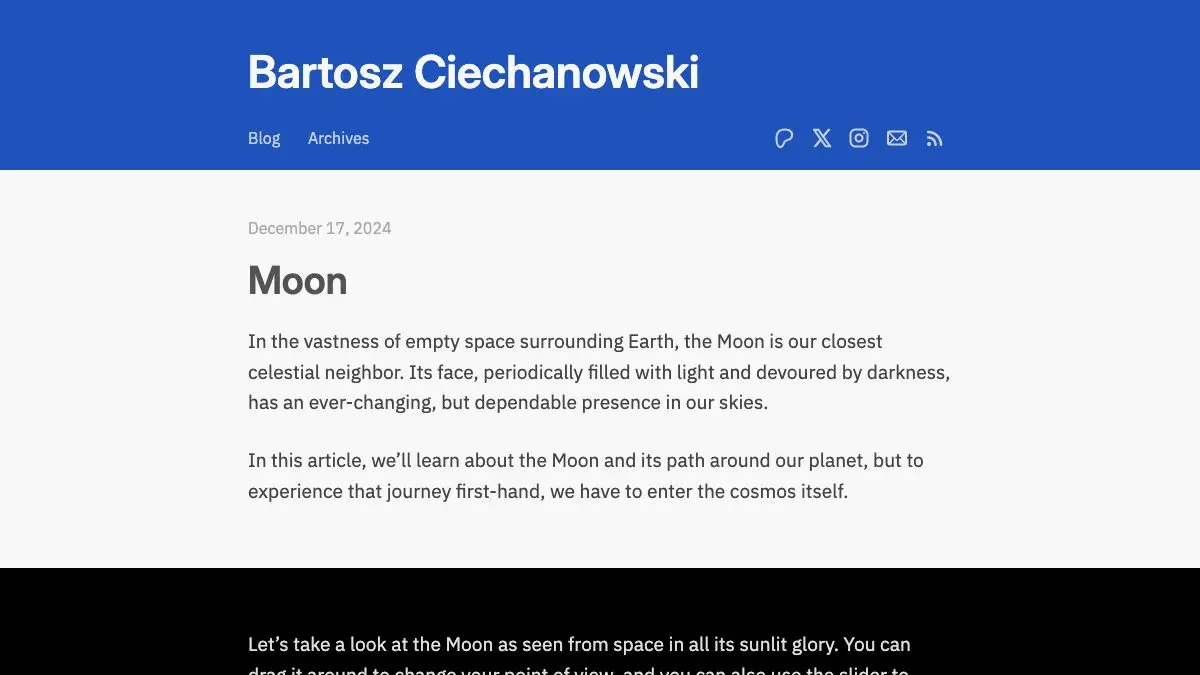
Bartosz Ciechanowski writes the best explainers on the internet, and he does it maybe twice a year. His site is a small collection of articles about how physical things actually work, gears, lenses, mechanical watches, GPS, sound, engines, the Moon, and every single one is stuffed with interactive 3D models you can grab, spin, and break. You don’t read these articles so much as operate them.
What is Bartosz Ciechanowski’s site?
It’s a personal blog that happens to outclass most textbooks. The format is consistent: pick one physical system, start from something almost embarrassingly simple, and build up in tiny increments until you understand the whole machine. Between the paragraphs sit live simulations. Drag a slider, and the lens moves. Scrub time, and the escapement in the watch ticks forward. Toggle a switch, and the exaggerated scale snaps back to reality.
The genius is in the pacing. Nothing is introduced before you need it, and nothing is skipped because it’s “obvious.” The Moon article, for instance, walks from basic orbital mechanics through tides, eclipses, and the way lunar dust scatters light, and at every step there’s a thing to poke. By the end you don’t just know that the Moon shows us the same face, you’ve spun the model yourself and watched why.
He publishes roughly once a year. That’s not laziness, it’s the cost of building bespoke WebGL simulations for every concept in a 15,000-word article. The archive is tiny and there is no filler in it.
What’s in the archive?
A decade of work, and it’s worth reading all of it:
- Moon and Earth and Sun: orbits, seasons, phases, eclipses, tides, all draggable.
- Airfoil and Naval Architecture: why planes fly and why ships don’t tip over, without the usual lies about lift.
- Mechanical Watch: the one that made the internet collectively lose its mind. Every gear, every jewel, animated.
- Internal Combustion Engine and Gears: the mechanical fundamentals, taken apart piece by piece.
- Bicycle: steering geometry and balance, which turn out to be far stranger than you assumed.
- Cameras and Lenses, Lights and Shadows, Color Spaces, Alpha Compositing: an entire optics and graphics education hiding in four posts.
- Sound and GPS: waves and satellites, both made tangible.
- Curves and Surfaces, Tesseract, Exposing Floating Point: the math-and-computing corner, equally good.
Tips to get the most out of it
- Read on a laptop or desktop. The simulations are the article. On a small screen you lose the thing that makes the site special. Give it a real browser window.
- Actually touch every diagram. It’s tempting to scroll past a static-looking figure. Don’t. Almost every one of them moves, and the paragraph after it assumes you played with it.
- Budget an hour, not five minutes. These are long. Bookmark and come back rather than skimming, skimming one of these is like skimming a lab.
- Toggle the “exaggerated” views. Several articles let you switch between true scale and a distorted version. Flipping between the two is where the intuition actually forms.
- Start with Mechanical Watch or Gears. They’re the most immediately delightful, and they’ll convince you to read the harder ones.
If you like Bartosz Ciechanowski, also try…
- BetterExplained: the same intuition-before-formula philosophy, applied to math.
- How a Car Works: a full mechanical education on one machine, with clear diagrams throughout.
- Scale of the Universe: for when you want physics as spectacle rather than as study.
- If the Moon Were Only 1 Pixel: the perfect chaser after the Moon article.
More rabbit holes on the Learning & Education page. But block out an evening for ciechanow.ski first, it’s the rare site that leaves you smarter than it found you.
Frequently asked questions
What is ciechanow.ski?
It is the personal blog of Bartosz Ciechanowski, where he publishes long interactive explainers about how physical things work. Each article is packed with 3D simulations, sliders, and draggable diagrams that you manipulate as you read. Subjects include gears, cameras and lenses, mechanical watches, GPS, sound, the internal combustion engine, and the Moon.
Is Bartosz Ciechanowski's site free?
Yes. Every article is free to read with no paywall, no ads, and no account. Readers who want to support the work can do so through his Patreon, but nothing on the site is gated behind it.
How often does he publish?
Rarely, usually one or two articles a year. Each piece takes months of work because the interactive simulations are built from scratch for that specific subject. The archive is small by design and there is no filler in it.
Do the articles need any math background?
No. The explainers are built so you can understand them by playing with the diagrams rather than by reading equations. Some math appears when it helps, but the interactive models carry the explanation, which is why the articles work for curious beginners and engineers alike.