// 2026-07-23 · Learning & Education · by Bob Smith
How a Car Works: The Free Illustrated Guide to Cars
How a Car Works explains every major car system with clear illustrations and plain language. Free automotive engineering that makes the engine finally click.
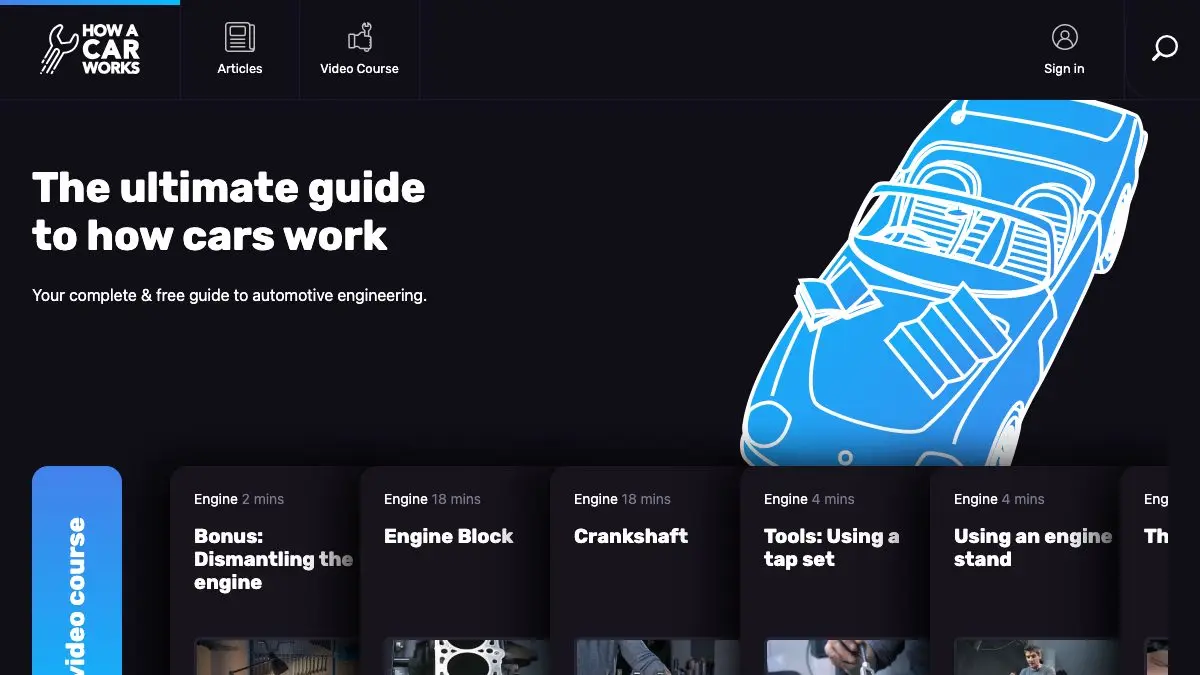
How a Car Works is a free, illustrated guide that explains how every major system in a car actually functions. Engine, gearbox, brakes, suspension, steering, cooling, electrics: each one broken down into plain language with cutaway diagrams that show you what is happening inside the metal.
If you have ever nodded politely while a mechanic explained something, this is the site that fixes that permanently.
What is How a Car Works?
How a Car Works calls itself your complete and free guide to automotive engineering, and it earns the description. The material is organized by system across more than fifteen categories, so you can start wherever your curiosity or your problem happens to be. Wondering what a differential actually does? There is an article. Confused about why your car has both a clutch and a torque converter? Also an article.
What separates it from a wiki page is the illustration. Cars are three-dimensional machines full of parts that move in relation to each other, and text alone cannot carry that. The cutaway diagrams here show the parts in place, in section, with the moving bits labeled, which is exactly what your brain needs to build a working model.
The site is funded by an optional paid product, the Car Mechanics Video Course: over 15 hours of filmed instruction going deep into engine mechanics, covering engine blocks, crankshafts, pistons and full teardown and rebuild work. The written guides stay free because people buy it. That is a funding model worth respecting.
What can you do on How a Car Works?
- Read your way through a whole system. Start at the engine basics and work outward. Each article assumes the previous knowledge without assuming an engineering degree.
- Look up a specific part when a mechanic mentions something you do not recognize, before you agree to pay for it.
- Understand a warning light or a symptom. Knowing how the cooling system or the braking system is laid out makes a strange noise far less mysterious.
- Prep for buying a used car. Understanding what a timing belt does, or why a slipping clutch matters, changes how you inspect and how you negotiate.
- Take the video course if you want to go from understanding an engine to actually opening one, with 15-plus hours of detailed engine work on film.
- Browse by category across engine, transmission, brakes, suspension, steering, fuel, ignition, electrics and more.
Tips to get the most out of it
- Start with the four-stroke cycle even if you think you know it. Every other engine article assumes it. Ten minutes here makes the next twenty articles dramatically easier.
- Read the article for the system, then go look at your own car. Pop the bonnet with the page open on your phone. Matching the diagram to the actual lump of metal in front of you is where the knowledge sticks.
- Follow one system all the way through rather than grazing. Doing the entire braking chain, from pedal to pad, gives you a complete mental model. Random browsing gives you trivia.
- Use it before a garage visit, not after. Reading up on the system you are about to discuss turns a one-sided conversation into an actual one, and mechanics generally appreciate a customer who understands what they are describing.
- Pay attention to the older technology articles. The site covers carburettors and mechanical distributors alongside modern systems. That history is not filler: understanding the simple mechanical version first makes the electronic version far easier to grasp.
- Bookmark the category index, not individual articles. You will come back with a different question every time, and the index is the fastest route to whatever it is.
If you like How a Car Works, also try…
- Bartosz Ciechanowski: interactive essays on mechanical systems that are, frankly, the gold standard for this kind of explanation.
- Animated Knots: the same hands-on clarity applied to rope, one step at a time.
- BetterExplained: intuition-first explanations for the math behind the machines.
- Khan Academy: free structured physics and engineering courses when you want the theory underneath.
Find more sites that teach properly in our Learning & Education collection.
Frequently asked questions
What is How a Car Works?
How a Car Works is a free illustrated guide to automotive engineering that explains how every major system in a car functions, from the engine and transmission to the brakes, suspension, steering and electrics. Articles are organized by system and written in plain language with cutaway illustrations. It bills itself as a complete and free guide to how cars work.
Is How a Car Works free?
The written guides are free to read with no account required. The site is funded by an optional paid video course, the Car Mechanics Video Course, which features over 15 hours of in-depth engine rebuilding footage. You never need to buy it to read the articles.
Who is How a Car Works for?
It suits anyone who wants to understand their car rather than just drive it: new drivers, home mechanics, people about to buy a used car, and curious readers who like knowing how machines work. It assumes no prior knowledge and builds up from fundamentals.
What does the Car Mechanics Video Course cover?
It is a filmed, in-depth course covering engine mechanics in detail, including engine blocks, crankshafts, pistons and the process of stripping and reassembling an engine, across more than 15 hours of video. It is the paid product that funds the site's free written guides.