// 2026-05-04 · Music & Audio · by Bob Smith
Every Noise at Once: A Map of Every Music Genre
Every Noise at Once plots thousands of music genres on one giant scatterplot. Find drift phonk, throat singing and stomp and holler, then go exploring.
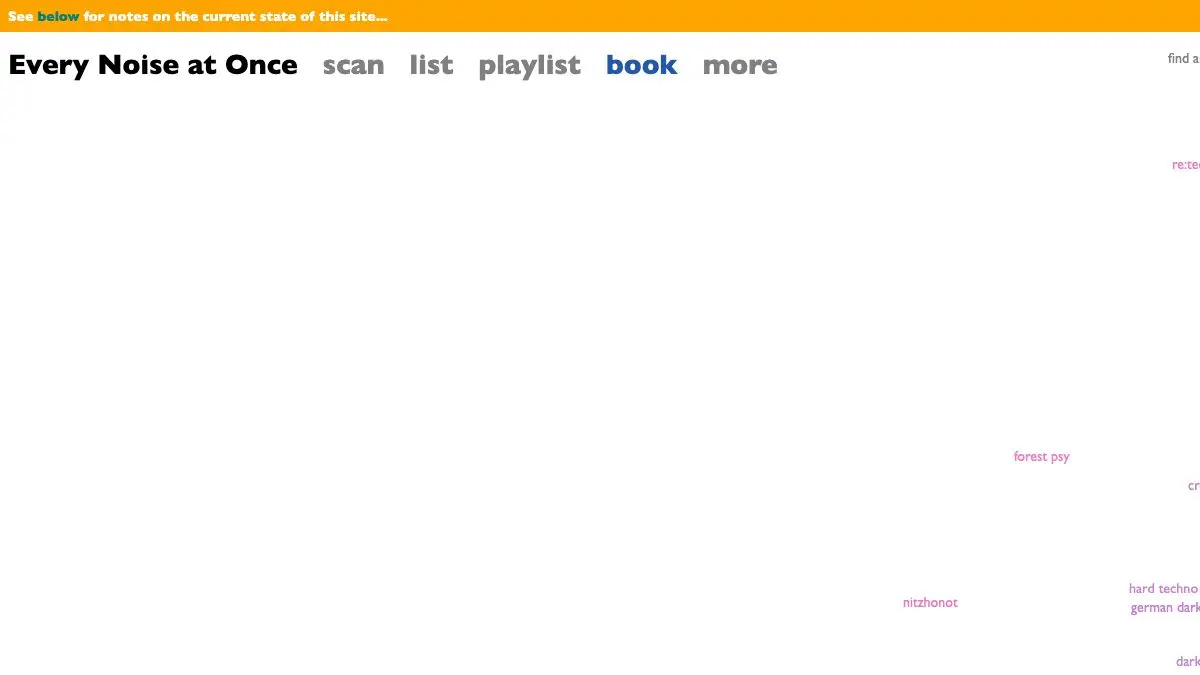
Every Noise at Once is a single enormous page that plots thousands of music genres as a scatterplot, positioned so that genres which sound alike sit near each other. It was built by Glenn McDonald, and it is the closest thing anyone has made to a map of all recorded music. Scroll it and you will find genres you have never heard of, in quantities that feel illegal.
Deep filthstep. Charred death. Stomp and holler. Bubblegum dance. Vintage taiwan pop. These are real.
What is Every Noise at Once?
Most music sites organize by popularity. Every Noise at Once organizes by sound. The page is a dense field of genre names, each one placed by acoustic character rather than alphabet or chart position, so the map has neighborhoods. Wander into one corner and everything around you is bright and percussive; wander into another and it all goes soft, slow and enormous.
Roughly speaking, the vertical axis runs organic at the bottom to mechanical and electric at the top, and the horizontal runs from dense and atmospheric on the left to spiky and bouncy on the right. You don’t need to memorize that. You just need to notice that when you find something you like, the things near it are also things you’ll like. That is the whole navigation system, and it’s brilliant.
Then there’s the second layer: click the little arrow beside a genre and you get an entire map of that genre, with its artists laid out by the same logic. Central artists sit in the middle, weird outliers sit at the edges. It’s a genre’s family tree rendered as geography.
What can you do on Every Noise at Once?
- Scroll and read. Honestly, half the joy is the names. “Escape room.” “Vapor twitch.” “A cappella.” “Nordic folk metal.” The taxonomy is a comedy set on its own.
- Follow the arrow. The
»next to each genre opens that genre’s own artist map: this is where you find new bands rather than new labels. - Use the list view. If the scatterplot is overwhelming, the alphabetical list gives you the same universe in a scannable column.
- Find the playlist for a genre. The site is famous for its companion “sound of” playlists, one per genre, so you can actually hear what a name means instead of guessing.
- Triangulate your taste. Find two genres you already love, look at what sits between them on the map, and go there. It works with unnerving accuracy.
McDonald also wrote a book about how streaming changed music, which is linked from the site, worth knowing if the map makes you curious about who built it and why.
Tips to get the most out of it
Use Ctrl/Cmd + F. The page is one gigantic document. If you’re hunting for something specific, “cumbia”, “shoegaze”, “trance”, browser search is dramatically faster than scanning, and it reveals every variant at once.
Search a country, not a genre. Type “swedish”, “nigerian”, “japanese” or “brazilian” and watch how many distinct scenes come back. This is the fastest route out of your algorithmic bubble.
Zoom out in your browser. Hit Ctrl/Cmd + - a couple of times and suddenly you can see the shape of the whole map. The clusters become obvious and navigating by region actually works.
Pick the ugliest name on screen. Genres with absurd names are usually the most fun to investigate. “Skweee” is a real thing. Go find out.
Explore the artist maps, not just the genre map. The top-level page is the famous bit, but the per-genre artist maps are where you actually discover music. Edge artists are the interesting ones.
Treat it as a reference, not a jukebox. It’s a taxonomy first. Use it to name the thing you like, then take that name anywhere you listen to music.
If you like Every Noise at Once, also try…
- Musicmap: the historical counterpart: a huge genealogy of popular music genres with history and audio examples for each branch.
- Radio Garden: travel by geography instead of genre, listening to live local stations on a spinning globe.
- Radiooooo: pick a country and a decade and hear what was actually playing there.
- Forgotify: for when you want the opposite of a map: a track nobody on Earth has ever streamed.
Plenty more in Music & Audio.
Open Every Noise at Once, search a country, and follow the first arrow that looks strange. You’ll come out the other side with three new favorite bands and a genre name you can’t pronounce.
Frequently asked questions
What is Every Noise at Once?
Every Noise at Once is a website by Glenn McDonald that maps thousands of music genres onto a single scatterplot. Genres sit near each other when they sound alike, so the whole page works as a navigable atlas of recorded music. Each genre also has its own map of the artists inside it.
Is Every Noise at Once free?
Yes, the site is free and open to anyone with a browser. There is no account, no paywall and no app, you just load the page and start exploring the genre map.
How is the Every Noise at Once map arranged?
The layout is based on acoustic similarity rather than alphabetical order. Broadly, the vertical axis runs from more organic and acoustic at the bottom to more mechanical and electric at the top, and the horizontal axis runs from denser and more atmospheric on the left to spikier and bouncier on the right.
How many genres are on Every Noise at Once?
Several thousand, and the list is famously granular, it separates things like 'chillwave' and 'vaporwave', or dozens of regional variants of drill and phonk. Clicking through to a single genre opens a second map of the artists who define it.