// 2026-08-05 · Learning & Education · by Bob Smith
Everything2: The Encyclopedia That Wanted to Be Literature
Everything2 is a writing community from 1999 where entries are essays, memoir and poetry rather than neutral facts. It predates Wikipedia and is still running.
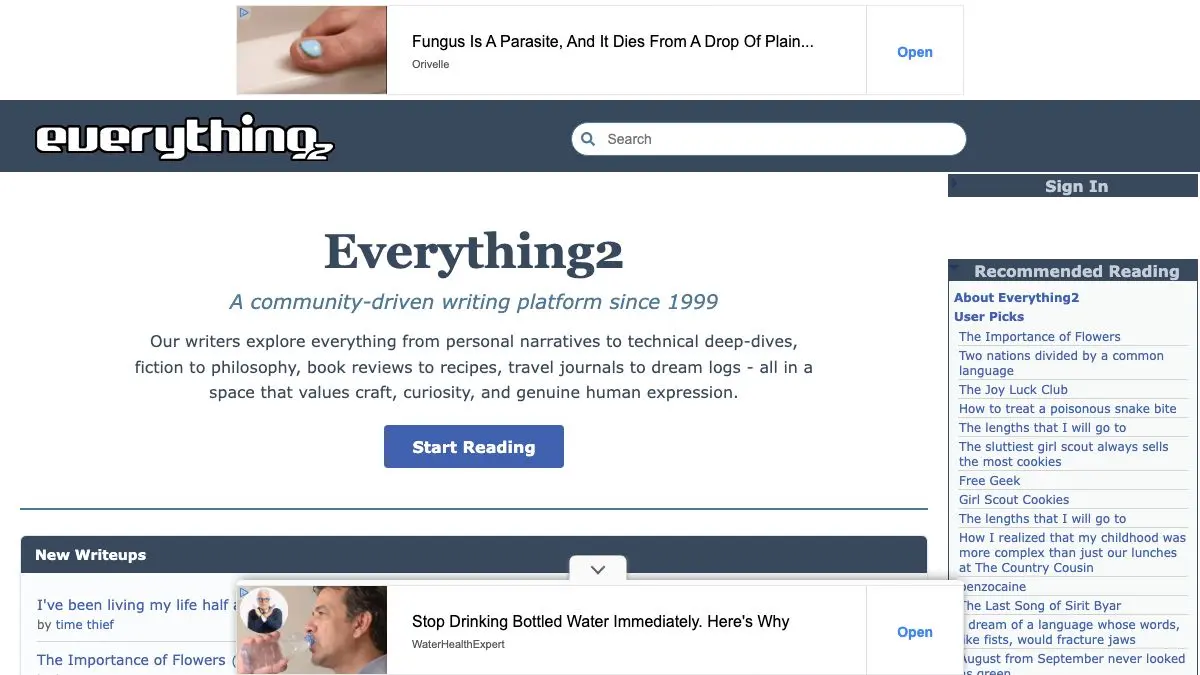
Everything2 is what the internet built before it decided that reference material had to be neutral. It launched in 1999 with a database of topics and a single unusual rule: many people could write about the same thing, separately, in their own voices, and all of it stayed.
The result is a site where the entry on a particular type of tree might contain a botanical description, a childhood memory, a poem, and someone’s account of falling out of one.
What is Everything2?
It grew out of an earlier system called Everything, built by Nate Oostendorp in the orbit of Slashdot, and inherited a community that was already comfortable with long, argumentative, personal writing on the web. When E2 arrived in 1999, Wikipedia did not exist yet. The obvious model for a collaborative knowledge site had not been established, so E2 established a different one.
The architecture is the philosophy. A node is a title, nothing more, and any number of writeups can hang off it. Nobody edits anyone else’s writeup into consensus. If you disagree with the existing entry on a topic, you do not correct it, you write your own underneath, and both stand with their authors’ names attached. The neutral point of view was never the goal. The interesting point of view was.
That decision means E2 does things an encyclopedia structurally cannot. It carries fiction, personal essays, day logs, recipes with commentary, technical explanations written with jokes in them, and long pieces about places that no reference work would ever cover. The house style that emerged from thousands of contributors is dry, self-aware, unusually literate, and prone to sudden earnestness.
There is a full social machine underneath: users called noders, upvotes, experience points, levels that grant more voting power, a chat system, editors and administrators, and an ecosystem of quests and writing challenges that push people to produce work on themes. Writeups considered exceptional get marked as cool and promoted, which functions as the site’s editorial front page.
It has been running continuously for over two decades, which in web terms is geological. Wikipedia won the encyclopedia question comprehensively, and rather than fight that, E2 drifted further toward what it was always better at: writing that a person made on purpose.
What can you do with Everything2?
- Hit a random node. The core E2 experience. You do not know if you are getting an essay on cryptography or someone’s account of a bad job in 2004.
- Read multiple takes on one topic. Scroll a busy node and watch several writers approach the same title from completely incompatible angles.
- Browse the cool and new writeup lists. Editorially highlighted work and fresh submissions, both linked from the front page.
- Read the day logs. Dated personal entries, which over twenty-five years have accumulated into an enormous informal diary of ordinary internet life.
- Find the fiction and poetry. Substantial creative writing sits alongside the factual material, indexed by the same node system.
- Write and get edited. Register, read the guidelines, and submit. Real editors will give real feedback, which is rarer than it should be.
- Join a writing quest. Themed challenges run regularly and are the main way new writers get pulled into the community.
Tips to get the most out of it
Do not use it as a reference. You will be disappointed, and you will miss the point. Look things up on Wikipedia; come here to read about them.
Read the whole node, not the top writeup. The best piece is frequently third or fourth down, written by someone with an entirely different relationship to the subject.
Follow the hard links. Writers embed links inside sentences, often as jokes or asides. Following them is the intended navigation method and it is how you end up eleven nodes from where you started.
Check the dates. Something written in 2001 about the internet, or about a job, or about a war, reads very differently once you notice when it was written. The timestamps do a lot of quiet work here.
Read the guidelines before writing anything. The community has strong opinions about what belongs, and a rejected first writeup discourages people who would have been fine on the second attempt.
Give it an evening, not five minutes. The site is not designed for a quick hit. Its rhythm assumes you are settling in, and it repays that.
If you like Everything2, also try…
- MetaFilter: another long-running community where the comments are frequently better than the link.
- Arts & Letters Daily: curated essays and criticism from a site of exactly the same vintage.
- Wiby: a search engine for the small, handmade web that E2 grew up alongside.
- Futility Closet: short, strange, well-written entries on things nobody else bothered to record.
More places that reward reading rather than scanning in Learning & Education and Weird & Wonderful.
Frequently asked questions
What is Everything2?
Everything2 is a collaborative writing community launched in 1999, built around topic pages called nodes that can hold multiple independent pieces of writing called writeups. Unlike an encyclopedia, entries are signed, subjective and stylistically varied, ranging from technical explanation to memoir, fiction and poetry. It is still active today.
Is Everything2 the same as Wikipedia?
No, though they are often compared because Everything2 came first and covers similarly broad ground. Wikipedia aims for one neutral article per topic; Everything2 allows many authored takes on the same title, keeps the author's voice, and welcomes creative writing. It is closer to a shared literary magazine organized by subject than to a reference work.
Is Everything2 free to use?
Yes. Reading is free and open to anyone, and creating an account to write and vote is also free. The site is community-run and has no subscription requirement.
Can anyone write on Everything2?
Anyone can register and submit writeups, but the site has real editorial standards and experienced editors who review new contributions. Short, low-effort or purely factual stub entries are frequently removed, and new writers are usually pointed at the site's guidelines first. The bar is quality of writing rather than credentials.