// 2026-08-05 · Maps & Exploration · by Bob Smith
Falling Fruit: A World Map of Free Food Growing in Public
Falling Fruit maps edible trees and forageable plants on public land worldwide, combining city tree inventories with sightings added by foragers. Free to browse.
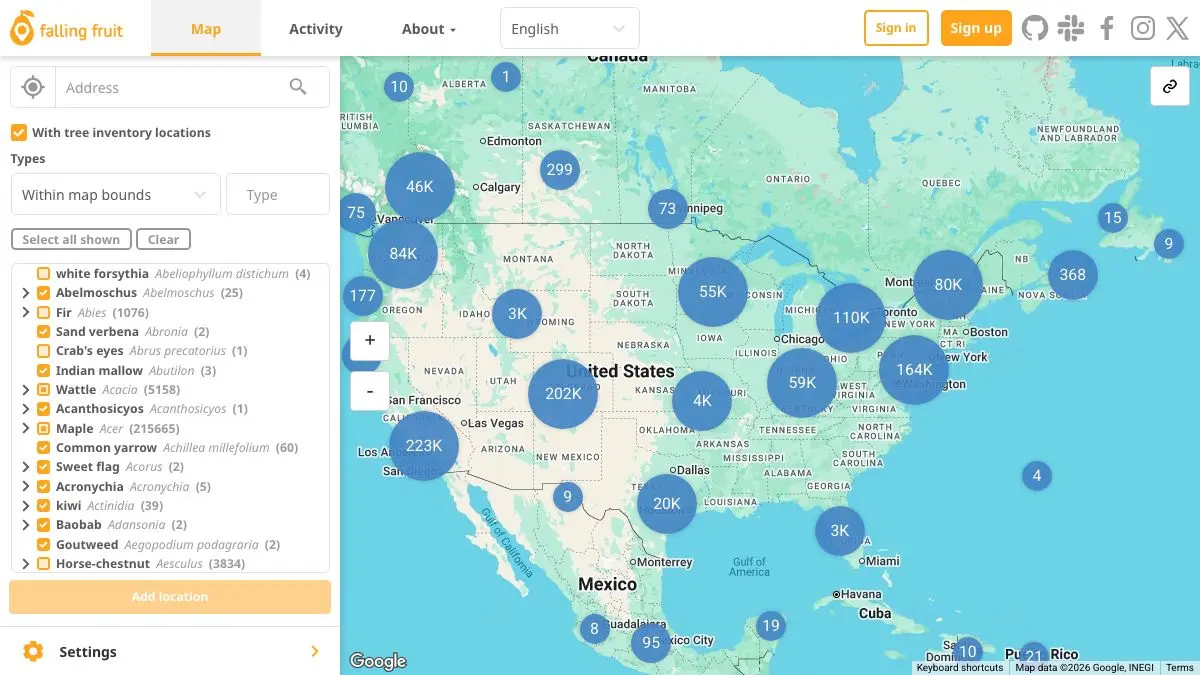
Falling Fruit is a map of free food growing in public. Fig trees on a sidewalk in Sacramento. Mulberries hanging over a fence in Berlin. Rosemary the size of a hedge outside a municipal parking lot. Someone has been quietly cataloging all of it, and there are now well over a million locations on the map.
Zoom to your own street. There is a decent chance something edible is already pinned within walking distance, and an even better chance you have walked past it for years.
What is Falling Fruit?
The idea started in Colorado in 2013, from Ethan Welty and Caleb Phillips, and it rests on a fairly obvious observation that almost nobody acts on: cities are full of fruit trees, and almost all of that fruit rots on the pavement. Not because anyone objects to it being eaten, but because nobody knows it is there.
The clever move was not building a map for foragers to fill in by hand. It was realizing that a lot of the data already existed. Municipal governments maintain street tree inventories with species and coordinates for every tree they are responsible for, largely for maintenance purposes. Falling Fruit imports those, filters out everything inedible, and suddenly an entire city appears on the map without a single person walking it.
On top of that sits the human layer: individual sightings added by users, with photos, notes and observations about when things ripen. That is where the map gets its texture. A city tree inventory tells you there is an apple tree at a coordinate. A forager’s note tells you it is a cooking apple, it drops in late September, and the neighbors do not mind.
The project is open in the way these things should be. The data is downloadable, the code is public, and the whole thing is run more like a public utility than a startup. There is no feed, no gamification, no attempt to convert foraging into engagement metrics.
The honest caveat, which the site makes itself, is that a pin is not permission. Land ownership is messy, local rules vary enormously, and a tree that overhangs a sidewalk may still belong to somebody. The map tells you where things grow. The rest is on you.
What can you do with Falling Fruit?
- Search your own neighborhood. Type an address and see what is already mapped nearby. This is the step that converts most people.
- Filter by species. Narrow the map to a single type, which is how you find out your city has forty walnut trees and you knew about none of them.
- Read the observations. Many pins carry notes from people who have actually been there, including ripening dates and whether the fruit is worth eating.
- Add new locations. Found something? Drop a pin, name the species, add a photo. It takes about a minute.
- Update stale pins. Trees get cut down, construction happens. Marking a location as gone is as valuable as adding a new one.
- Browse imported datasets. Whole city tree inventories are visible as layers, which is worth exploring even if you never pick anything.
- Download the data. The locations are openly licensed and available in bulk for mapping projects and research.
- Use it while traveling. The map is global, so it works as a strange, delicious lens on an unfamiliar city.
Tips to get the most out of it
Check the season before you walk. A map pin is timeless and fruit is not. The observations attached to a location are usually the best guide to when it is actually worth visiting.
Trust user pins more than imported ones. Imported city inventories are broad but blunt: they know the species, not whether the tree fruits well or is drenched in road spray. A pin with a photo and a note behind it is worth ten from a database.
Be sensible about where things grow. Street trees at a busy intersection collect exhaust and whatever the city sprayed on them. Wash everything, and prefer parks and quiet streets.
Identify before you eat. The map is a location tool, not an identification guide. If you are not certain what a plant is, do not put it in your mouth. This applies double to anything mushroom-shaped.
Take only a share. The unwritten rule of urban foraging is to leave plenty, for wildlife and for whoever is walking past tomorrow. Stripping a tree is how neighborhoods end up hostile to the whole idea.
Give something back. The map only works because people update it. One photo, one ripening note, one flag on a tree that no longer exists, and it stays useful for everyone else.
If you like Falling Fruit, also try…
- Atlas Obscura: the same crowd-mapped instinct pointed at strange places rather than edible ones.
- Native Land: another map layered over the familiar one, showing what is really underneath it.
- Supercook: once you have come home with three pounds of unexpected plums, this tells you what to do with them.
- StillTasty: the boring but essential companion question of how long any of it will keep.
More reasons to look at your own city differently in Maps & Exploration, and more practical kitchen backup in Tools & Utilities.
Frequently asked questions
What is Falling Fruit?
Falling Fruit is a collaborative world map of edible plants growing in public and semi-public space: fruit and nut trees on sidewalks, berry bushes in parks, herbs on verges. It combines large imported datasets, such as municipal street tree inventories, with individual sightings added by users. Browsing the map is free and requires no account.
Is Falling Fruit free?
Yes, the map is free to browse and free to contribute to. It is run as an open project and the underlying data is openly licensed, so the locations can be downloaded and reused. Creating an account is optional and only needed if you want to add or edit locations.
Is it legal to pick fruit from trees on Falling Fruit?
It depends entirely on where you are. Rules about foraging on public land vary by country, city and even by park, and some pins on the map sit on land that is not actually public. Falling Fruit is a map of where things grow, not a permission slip, so check local rules and never pick from private property without asking.
How do I add a location to Falling Fruit?
Sign up for a free account, find the spot on the map, and add a new location with the species, a description and optionally a photo. You can also leave observations on existing pins, noting whether the tree is fruiting, when it ripened, or that it has been cut down. Those updates are what keep the map useful.