// 2026-08-05 · Weird & Wonderful · by Bob Smith
PostSecret: Strangers Mailing In Their Secrets, Every Sunday
PostSecret publishes anonymous secrets that people write on homemade postcards and mail to a house in Maryland. New ones go up every Sunday, free to read.
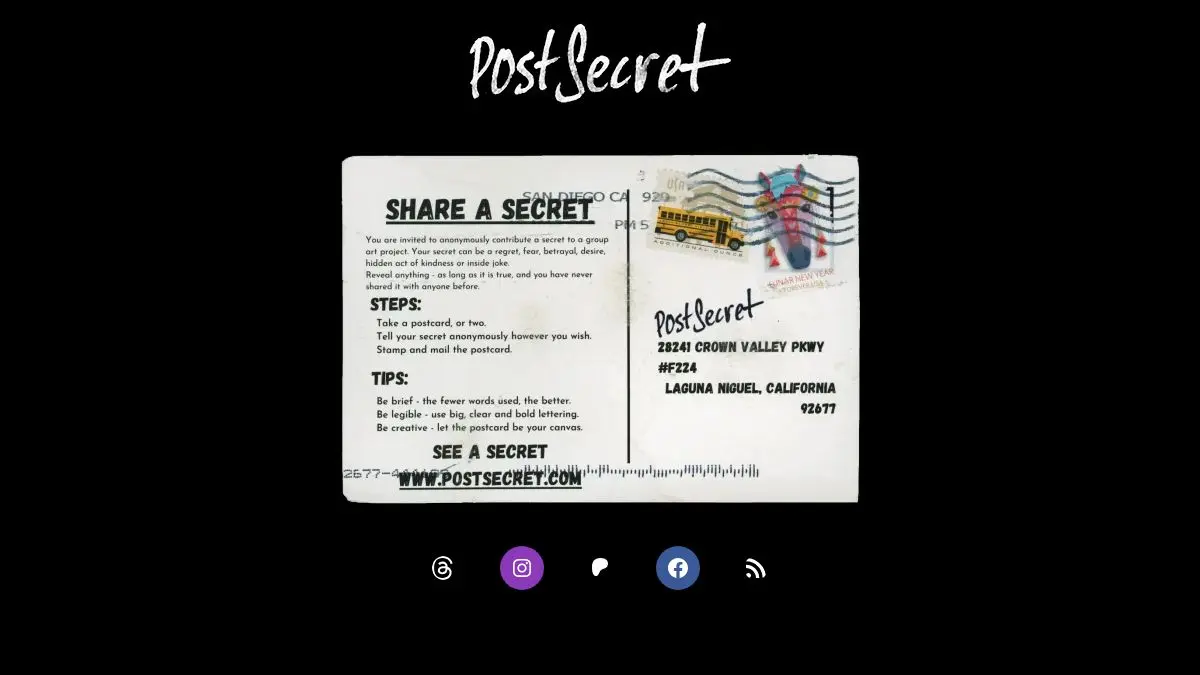
PostSecret is a website where strangers mail in the things they have never told anyone. Not typed into a form, not posted from a throwaway account. Written by hand on a physical postcard, often decorated, collaged, painted or built out of something meaningful, and dropped in an actual mailbox addressed to a house in Maryland. Every Sunday, a new batch goes up.
There is no comment section. There is nothing to click. You just read them.
What is PostSecret?
In 2004, Frank Warren printed three thousand blank, self-addressed postcards and handed them out on the street in Washington, DC. The instruction was simple: write a secret you have never told anyone, do not sign it, mail it back. It was meant to be a short art project.
The cards kept coming after the project ended. They came from people who had been handed one and passed it along, then from people who had only heard about it, then from all over the world. Two decades later they are still arriving, hundreds of thousands of them, at an address that has been printed on the site for so long that it is effectively an internet landmark.
The secrets range enormously. Some are funny, small confessions about workplace pettiness or food or the lies we tell about how much we like someone’s cooking. Some are devastating, about grief, addiction, abuse or a marriage that ended years before anyone told the children. A surprising number are simply lonely. The genius of putting them side by side is that the trivial ones make the serious ones bearable, and the serious ones make the trivial ones feel like a kindness.
The format has never changed and never modernized. No infinite scroll, no engagement metrics, no algorithm deciding which secret you deserve. A weekly update, a stack of scanned cards, and silence around them. It looks almost primitive next to a modern social platform, and that is precisely why it works: nobody is performing for likes, because there are none.
Alongside the site, the project has produced several bestselling books, traveling gallery exhibitions and a long-running series of live talks. It has also been closely associated with suicide prevention and mental health support, and Warren has been open about the fact that some of the mail arriving is a cry for help rather than a confession.
What can you do with PostSecret?
- Read the Sunday Secrets. A fresh set of cards is posted weekly. This is the main event and it takes about five quiet minutes.
- Send your own. Make a postcard, write something true, do not sign it, mail it. Nobody will ever know it was you, including the project.
- Look at the cards as objects. Many are genuinely accomplished pieces of collage or hand lettering. People put real craft into anonymity.
- Browse the archives and books. The published collections gather years of cards into themed volumes, which reads very differently from a weekly drip.
- Check the events and talks. Warren has toured extensively, and live PostSecret events include secrets read aloud from the audience.
- Find the support links. The site has long pointed toward crisis and mental health resources, positioned exactly where someone in trouble might see them.
Tips to get the most out of it
Read it on Sunday, as intended. The weekly rhythm is doing a lot of work. Reading a year’s worth in one sitting flattens everything into noise, whereas a handful once a week actually lands.
Do not go looking for a comment section. There is not one, and the absence is the design. If you feel an urge to respond to a card, the intended outlet is to make a card of your own.
Look at the physical object, not just the words. What someone glued down, what photograph they cut up, what handwriting they used when they thought no one would trace it, all of that is part of the confession.
If you send one, do not hint. People occasionally mail secrets with enough identifying detail that the intended audience of one would recognize it. That is a different project, and a riskier one.
Take the sad ones seriously. Some cards are plainly written by someone in a bad place. The site keeps support resources visible for a reason, and it is worth knowing they are there.
Give it your full attention or skip it. This is not background browsing. Half-reading a stranger’s worst moment while scrolling something else is a slightly grim way to spend a Sunday.
If you like PostSecret, also try…
- Dear Next Visitor: leave a message for whoever loads the page after you, and read the one left for you.
- The Nicest Place on the Internet: strangers offering hugs, with roughly the same sincerity and none of the sorrow.
- FutureMe: write a letter to yourself years from now, and read the public ones other people wrote.
- Plane Crash Info: Last Words: a far bleaker archive of things people said when they thought nobody was listening.
The rest of the internet’s strange, sincere corners are filed under Weird & Wonderful.
Frequently asked questions
What is PostSecret?
PostSecret is an ongoing community art project where people mail an anonymous secret, written or collaged onto a homemade postcard, to a single address in Maryland. A selection is scanned and published on the site every Sunday. It began in 2004 as a short-term art experiment by Frank Warren and never stopped.
Is PostSecret free?
Yes. The site is free to read, carries no ads and requires no account. Warren has published several books collecting secrets and gives talks, but the weekly postings have always been free.
How do I send a secret to PostSecret?
You make a postcard, write a secret on it that you have never told anyone, and mail it to the address published on the site. Do not include your name or any return information. Only a small fraction of the cards received are posted, but the project has always maintained that the act of sending one is the point.
Are the secrets on PostSecret real?
There is no way to verify an anonymous postcard, and the project does not claim to. What can be verified is that hundreds of thousands of physical cards have genuinely arrived in the mail over two decades. Readers generally treat the collection as true in aggregate, whatever the status of any single card.