// 2026-06-26 · Entertainment & Fun · by Bob Smith
Sandspiel: The Falling-Sand Simulator You Can't Put Down
Sandspiel is a free browser falling-sand simulator where sand, water, fire and plants fight it out in real time, then you post the result to a public gallery.
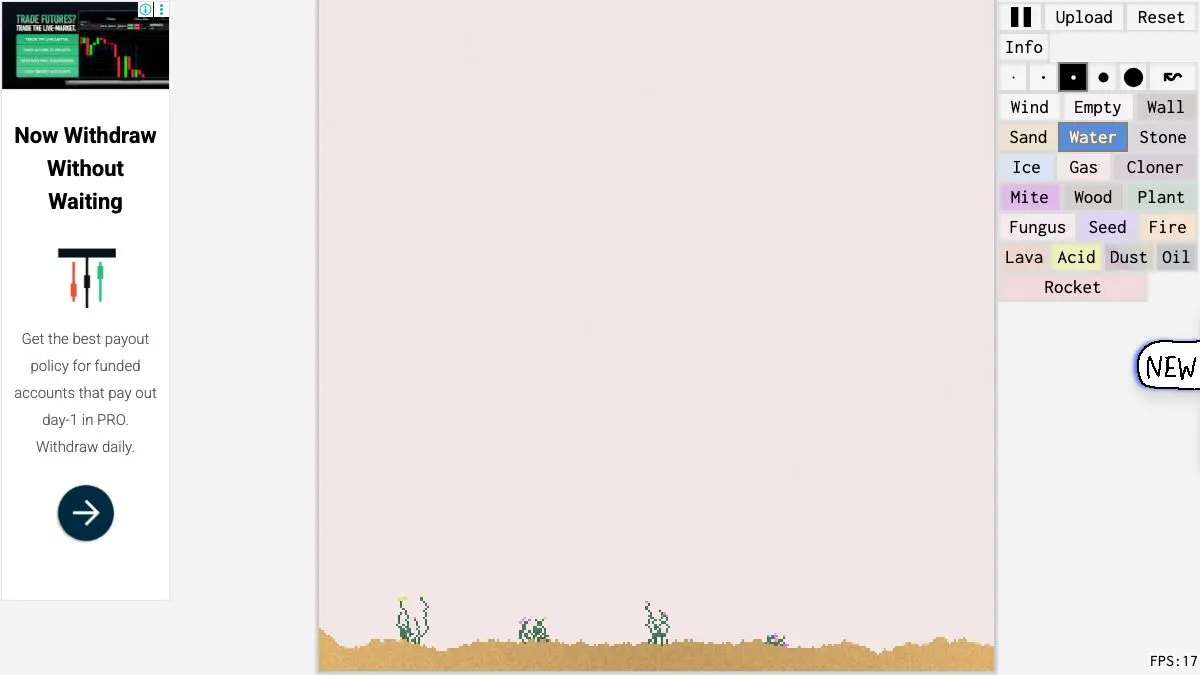
Sandspiel is a free falling-sand simulator that runs in your browser. You pick an element, sand, water, fire, plant, acid, paint it onto a black canvas with your cursor, and a particle physics simulation takes over from there. It’s part chemistry set, part art toy, part idle destruction machine, and it has a gallery where other players post what they made.
You will lose an hour to this. We’re not sorry.
What is Sandspiel?
Falling-sand games are one of the internet’s oldest and most stubbornly satisfying genres. The idea is simple: the screen is a grid of pixels, each pixel is a material, and every frame the materials obey a few tiny rules. Sand falls and piles up. Water flows and finds its level. Fire spreads to anything flammable and dies when it runs out of fuel. Nobody programmed the scene, you draw the ingredients and the rules do the rest.
Sandspiel is the gorgeous modern take on that idea. It’s smooth, it’s fast, it’s beautiful in a way falling-sand toys usually aren’t, and it doesn’t ask you for anything. No account, no download, no tutorial. There’s a palette of elements down one side and a big black rectangle waiting to be ruined.
The magic is emergence. You never quite know what a combination will do until you try it. Drop a seed of plant on wet sand and watch a vine climb. Set the top of that vine on fire and watch the flame race down. Pour water on the flame and get a cloud of steam that drifts up and condenses. None of that was scripted. It just happens.
What can you do on Sandspiel?
Everything starts with the element palette. Pick one, adjust the brush size, and draw.
- Sand and dust: the headliners. They fall, they pile, they slump into cones exactly the way real granular material does.
- Water and oil: liquids that spread, seep through gaps and pool at the bottom. Oil burns. Water doesn’t. Guess which one is more fun.
- Wood and plant: structure and fuel. Build a wooden frame, seed it with plant, then decide whether you’re a gardener or an arsonist.
- Fire and ice: heat propagates. Ice melts near flame. Flame gutters out near water. Temperature is genuinely simulated, not faked.
- Stone: the immovable stuff. Use it for walls, funnels, dams and mazes that channel everything else.
- Acid: eats through almost anything it touches. Excellent for demolishing a build you got bored of.
- Gas: rises, spreads, and is extremely flammable. Fill a chamber with it and light a match. You know you want to.
- Cloner: the sneaky one. It copies whatever material touches it, forever. This is how you build infinite waterfalls and permanent fires.
- Wind: not a material at all, but a force. Drag with it and you push smoke, flame and gas around like you’re stirring soup.
Then there’s the gallery, which is the reason the site lives at sandspiel.club rather than somewhere plainer. People save their scenes and publish them, and you can browse what everyone else built, load a scene into your own canvas, and keep messing with it. Half the joy is discovering that someone spent a Tuesday afternoon constructing an elaborate acid-powered Rube Goldberg machine and then just left it there for you.
Go and try it at sandspiel.club.
Tips to get the most out of it
- Build the container before you build the contents. Draw a stone bowl or funnel first, then fill it. Unconstrained sand just slides off the bottom of the screen and you get nothing. Walls are what turn a mess into a machine.
- The cloner is a cheat code. A single pixel of cloner touching water becomes an infinite spring. Put one at the top of the screen, feed it fire, and you have a permanent burning ceiling. Almost every impressive scene in the gallery uses cloner somewhere.
- Vary your brush size. A giant brush is for terrain and dumping. A one-pixel brush is for precision, cutting a hole in a dam, planting a single seed, placing one spark exactly where you want the chain reaction to start.
- Use wind as a camera move. Once a scene is burning, switch to wind and drag slowly across the flames. The smoke swirls follow your cursor and the whole thing suddenly looks cinematic.
- Save the accidents, not the plans. The scenes worth publishing are almost never the ones you designed. They’re the ones where you meant to make a fountain and accidentally made a volcano.
If you like Sandspiel, also try…
- The Powder Toy: the deep end of the same pool. Hundreds of elements, real pressure and heat simulation, and electronics you can wire into working logic gates.
- Orb Farm: by the same maker, but calm instead of chaotic. A sealed aquatic ecosystem you tend rather than destroy.
- WebGL Fluid Simulation: pure liquid, no rules to learn. Drag your cursor and swirl photoreal color around the screen.
- More time-sinks in Entertainment & Fun.
Frequently asked questions
What is Sandspiel?
Sandspiel is a free falling-sand simulator that runs in a web browser. You paint elements like sand, water, fire, wood and acid onto a canvas and a particle physics simulation decides what happens next. It also has a public gallery where players share the scenes they built.
Is Sandspiel free?
Yes. Sandspiel is completely free to play and there is nothing to install or sign up for. Open the page, pick an element from the palette, and start drawing.
Do I need to download anything to play Sandspiel?
No. Sandspiel runs entirely inside your browser tab on desktop and mobile. Touch and drag works the same way a mouse does, so a phone or tablet is a perfectly good canvas.
What elements are in Sandspiel?
The palette includes classics like sand, water, stone, wood, plant, fire, ice, oil, gas and acid, plus utility tools such as a cloner that endlessly copies whatever touches it and a wind tool that pushes smoke and flame around the screen. Each one reacts differently to everything else, which is where the fun lives.