// 2026-08-05 · Entertainment & Fun · by Bob Smith
Fold 'N Fly: A Searchable Database of Paper Airplane Designs
Fold 'N Fly collects dozens of paper airplane designs with step-by-step diagrams and videos, sorted by difficulty and by whether you want distance, air time or tricks.
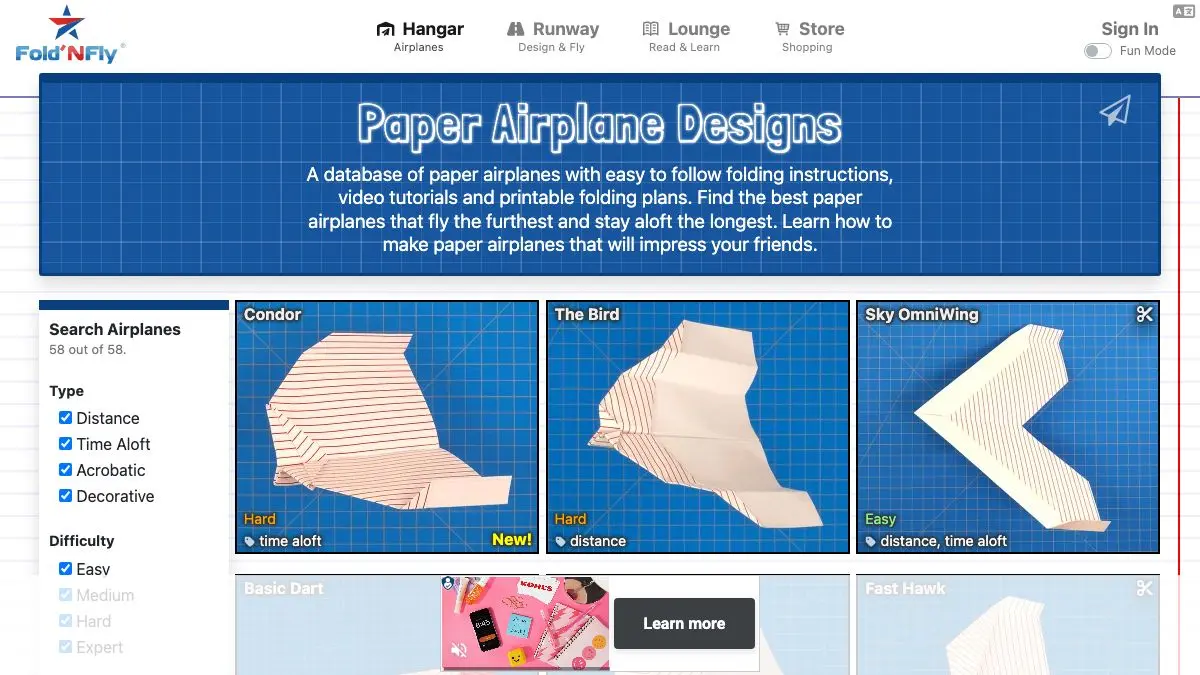
Fold ‘N Fly solves a problem you did not know was a problem until you needed a paper airplane and discovered that the one design you remember from school flies about four feet and then dives into the carpet.
It is a database. Dozens of designs, each with numbered folding diagrams, a printable sheet and usually a video, filterable by difficulty and by what you actually want the plane to do.
What is Fold ‘N Fly?
Paper airplane instructions on the internet are usually terrible. They arrive as a wall of blurry photos, or a nine-minute video where the first four minutes are an introduction, or a diagram at step six that skips a fold and leaves you holding an origami shape with no obvious relationship to flight.
Fold ‘N Fly is the corrective. Every design gets clean, numbered diagrams with the fold lines marked, presented on a single page you can scroll through at your own pace. There is a printable version, which matters more than it sounds: having the steps on paper next to the paper you are folding is dramatically easier than switching between a screen and your hands. Most designs also link to a video for the steps where a static diagram is genuinely ambiguous.
The organizing insight is that paper airplanes are not one thing. The site sorts designs by flight characteristic, because a plane built to travel a long distance and a plane built to stay in the air a long time are aerodynamically opposed. Distance designs are narrow darts with swept wings and a weighted nose, built to go fast and straight. Time-aloft designs have broad wings and low weight, built to glide slowly. Acrobatic designs do loops and boomerang returns. Decorative ones are not really about flying at all.
Difficulty is the other axis, running from designs a child can fold from memory up to models with a dozen precise steps that will punish sloppy creasing.
The whole thing is free, requires nothing, and works from a phone propped against a coffee cup, which is realistically how most people use it.
It is also one of the better websites to hand to a bored child, because it converts an afternoon into a physical activity involving scissors-free paper and immediate feedback, which is a rarer combination than it should be.
What can you do with Fold ‘N Fly?
- Filter by flight type. Choose distance, time aloft, acrobatic or decorative and get only the designs built for that job.
- Filter by difficulty. Sort from simple folds up to models that need genuine precision, so you can match the design to the folder.
- Follow numbered diagrams. Clear step-by-step illustrations with fold lines marked, one page per design.
- Print the instruction sheet. A printable version of the steps, which is far easier to follow at a table than a phone screen.
- Watch the video. Most designs include one for the steps where a diagram alone is ambiguous.
- Run a bake-off. Fold three designs from three different categories and throw them all. The difference in behavior is the fastest aerodynamics lesson available for free.
Tips to get the most out of it
Crease with something hard. A fingernail, a ruler edge, the back of a spoon. Sharp creases are the single biggest difference between a plane that flies and a plane that wobbles, and no design compensates for lazy folding.
Match the design to the room. Distance darts need a hallway or a field. Indoors, a time-aloft glider is far more satisfying because it stays up instead of hitting the wall in half a second.
Print the instructions for anything above beginner. The complex designs have steps where you need both hands and a clear view of the diagram at the same time. A printed sheet solves this; a phone that keeps sleeping does not.
Adjust the trailing edge after folding. A tiny upward bend at the back of the wings changes the flight enormously. Almost every plane that nosedives is fixable with a two-millimeter tweak rather than a refold.
Fold the same design twice. The second attempt is always noticeably better, and comparing the two flights makes it obvious how much of performance is technique rather than design.
Use plain printer paper first. It is what the diagrams assume. Experiment with heavier or lighter stock afterward, once you have a baseline to compare against.
If you like Fold ‘N Fly, also try…
- Animated Knots: the same idea applied to rope, with animations that show every stage of the tie.
- Ian’s Shoelace Site: one man’s exhaustive investigation into the lacing of shoes, and it is genuinely useful.
- How a Car Works: clear illustrated explanations for a considerably larger machine.
- Neal.fun: interactive toys for when you want the physics without the paper cuts.
More things to make and do in Entertainment & Fun and Learning & Education.
Frequently asked questions
What is Fold 'N Fly?
Fold 'N Fly is a free database of paper airplane designs. Each design has numbered folding diagrams, a printable instruction sheet and usually a video, and the collection can be filtered by difficulty and by flight characteristics such as distance, time aloft or acrobatics.
Is Fold 'N Fly free?
Yes, the whole site is free and requires no account. You can view the diagrams, print the instruction sheets and watch the videos without signing up for anything.
Which paper airplane flies the farthest?
Fold 'N Fly groups designs by intended flight type, and the distance category collects the narrow, dart-style planes built to cut through the air. Long-distance designs generally have swept-back wings, a heavy nose and a small wing area, which trades gliding time for speed and range.
What paper should I use for paper airplanes?
Standard printer paper is what almost every design assumes, and it is the right starting point. Heavier paper holds a crease better but adds weight, and lighter paper flies longer but deforms quickly, so it is worth folding the same design in a couple of weights once you have the technique down.