// 2026-08-05 · Tools & Utilities · by Bob Smith
Ian's Shoelace Site: The Definitive Archive of Tying Your Shoes
Ian's Shoelace Site catalogues dozens of lacing methods and knots, with diagrams, comparisons and a genuinely better bow that will not come undone.
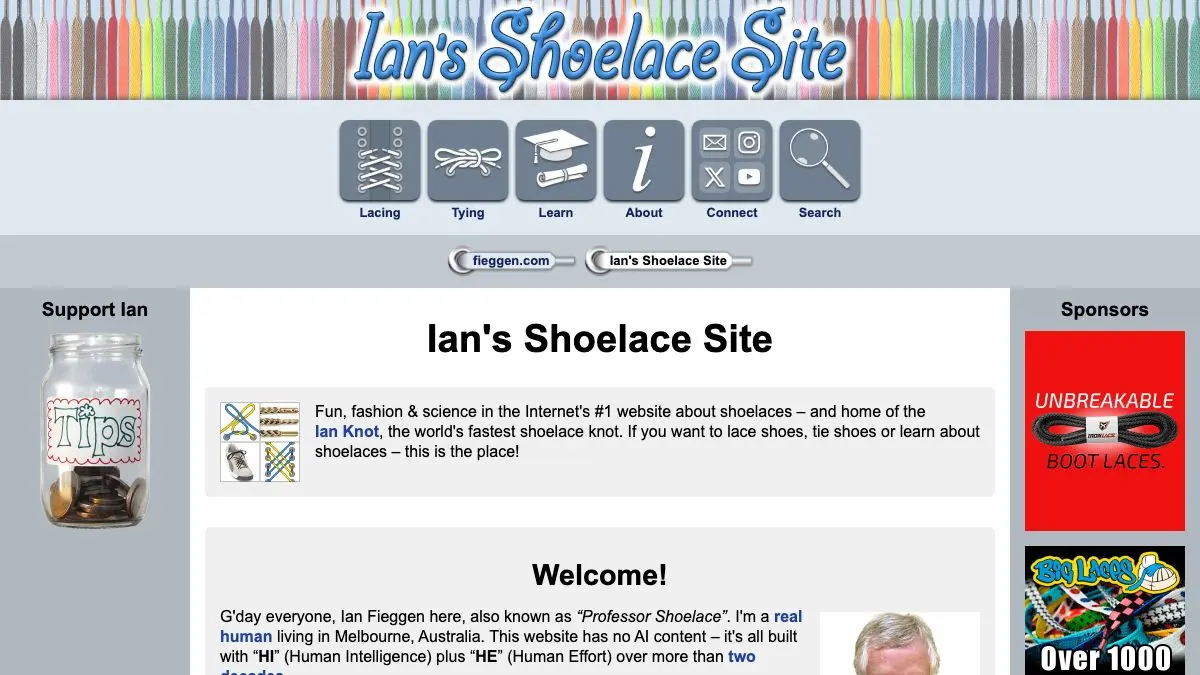
Ian’s Shoelace Site is what happens when one person decides to become the world authority on a subject everyone else considers finished. It documents dozens of ways to lace a shoe and dozens of ways to knot the result, with diagrams, comparisons, strength notes and a small amount of physics. It has been online since the 1990s and it is still the best resource on the topic by an enormous margin.
You will arrive because your laces keep coming undone. You will leave forty minutes later having learned that you have been tying a granny knot your whole life.
What is Ian’s Shoelace Site?
Ian Fieggen, an Australian who signs his work “Professor Shoelace,” started the site as a personal project and never stopped adding to it. The result is a reference work: not a blog, not a listicle, but a properly organized body of knowledge with consistent diagrams, cross-references and a clear taxonomy.
The site splits into two main halves. Lacing covers how the lace threads through the eyelets: criss-cross, straight bar, ladder, hidden knot, and a long tail of methods designed for specific feet and specific problems. Knots covers what you do at the top: the standard bow, the surgeon’s knot, the two-loop variations, and Ian’s own contributions.
The most famous of those is the Ian Knot, a way of tying an ordinary shoelace bow by forming both loops at once and pulling them through each other in a single motion. The knot it produces is identical to the standard one, it just gets there faster. Learning it takes a frustrating ten minutes and then becomes permanent.
The genuinely useful insight, though, is the granny knot problem. Most people tie a starting overhand in one direction and a finishing loop that does not mirror it. That produces a knot that sits crooked across the shoe and works itself loose with every step. Tie it balanced and it sits perpendicular and stays put. This is one small correction that fixes a lifelong annoyance, and the site explains it with better diagrams than anyone else.
Beyond that there are sections on lace length calculation, lace materials, and the accessibility angle: one-handed lacing, methods for people who cannot tie knots, and lacings designed for wide feet, high insteps and heel slip.
The design is unapologetically old-web. Dense navigation, plain layout, function over fashion. It is the site of somebody who cares far more about the content than the frame around it, and it is better for it.
What can you do on Ian’s Shoelace Site?
- Fix a knot that keeps slipping. The granny knot explanation is the highest-value page on the site and takes two minutes to read.
- Learn the Ian Knot. Follow the step diagrams until the movement clicks, then never tie a bow the slow way again.
- Browse dozens of lacing patterns. From practical (straight bar for dress shoes) to decorative (lattice, pentagram) to functional (hidden knot, so no bow shows at all).
- Solve a specific foot problem. Heel slip, pressure on the instep, wide forefoot, toe pain: there is a lacing designed for each, with an explanation of why it helps.
- Calculate lace length. Work out how long a replacement lace needs to be based on eyelet count and lacing method, instead of guessing at the shop.
- Find a stronger knot. The surgeon’s knot and the double-slip variants hold considerably better under load for boots, skates and sports shoes.
- Read the comparisons. Side-by-side tables rating methods on security, ease and speed, which is more rigor than the subject has any right to expect.
Tips to get the most out of it
Start with the knot, not the lacing. Almost everybody’s actual problem is the bow coming undone, and that is a five-minute fix. The decorative lacing patterns are fun but they are not what brought you here.
Check which way your bow sits. If the finished bow lies along the length of the shoe rather than across it, you are tying a granny knot. Reverse the direction of your starting overhand and it will straighten out immediately.
Give the Ian Knot a real attempt. It feels impossible for the first dozen tries because your hands are fighting three decades of muscle memory. Push through and it becomes automatic within a day or two.
Match the lacing to the shoe, not the look. Straight bar lacing on dress shoes looks cleaner and does not distort the leather. Criss-cross tightens better on athletic shoes. The site says which is which.
Use the hidden knot for anything you slip on and off. It hides the bow entirely inside the shoe, which looks tidy and stops laces catching on things.
Do not skip the lace length page before buying replacements. Laces come in a small number of standard lengths and the wrong one is genuinely irritating for the life of the shoe.
If you like Ian’s Shoelace Site, also try…
- Animated Knots: the same obsessive treatment applied to rope, with animated step-by-step tying.
- Fold ‘N Fly: a diagrammed catalogue of paper airplane designs, equally thorough about a small subject.
- MuscleWiki: click a body part, get the exercises, another reference that beats searching.
- StillTasty: the definitive answer to a domestic question nobody else bothered to catalogue.
More single-subject obsessives worth your time in Tools & Utilities and Learning & Education.
Frequently asked questions
What is Ian's Shoelace Site?
It is a long-running personal website by Ian Fieggen dedicated entirely to shoelaces. It documents dozens of ways to lace shoes, dozens of knots for securing them, plus sections on lace length, lace types and the mechanics of why knots slip. Each method comes with step-by-step diagrams and notes on what it is good for.
Is Ian's Shoelace Site free?
Yes, the whole reference is free to browse with no account. Ian has also written a book and sells some related items, but every lacing method and knot on the site is available at no cost.
What is the Ian Knot?
The Ian Knot is the site's best-known contribution: a method of tying a standard bow that forms both loops simultaneously rather than wrapping one around the other. The finished knot is the same shape as a conventional bow, but it is faster to tie once you have the hand movements down.
Why do my shoelaces keep coming undone?
Usually because the knot is tied unbalanced, producing a granny knot instead of a square knot. A granny knot sits skewed and works loose under repeated impact. The site explains how to spot the difference and how to correct it, either by reversing the direction of the starting overhand or of the finishing loop.