// 2026-08-05 · Music & Audio · by Bob Smith
Ishkur's Guide to Electronic Music: The Family Tree, With Opinions
Ishkur's Guide maps every electronic music subgenre into a playable, annotated family tree, with sample tracks and commentary that is frequently very rude.
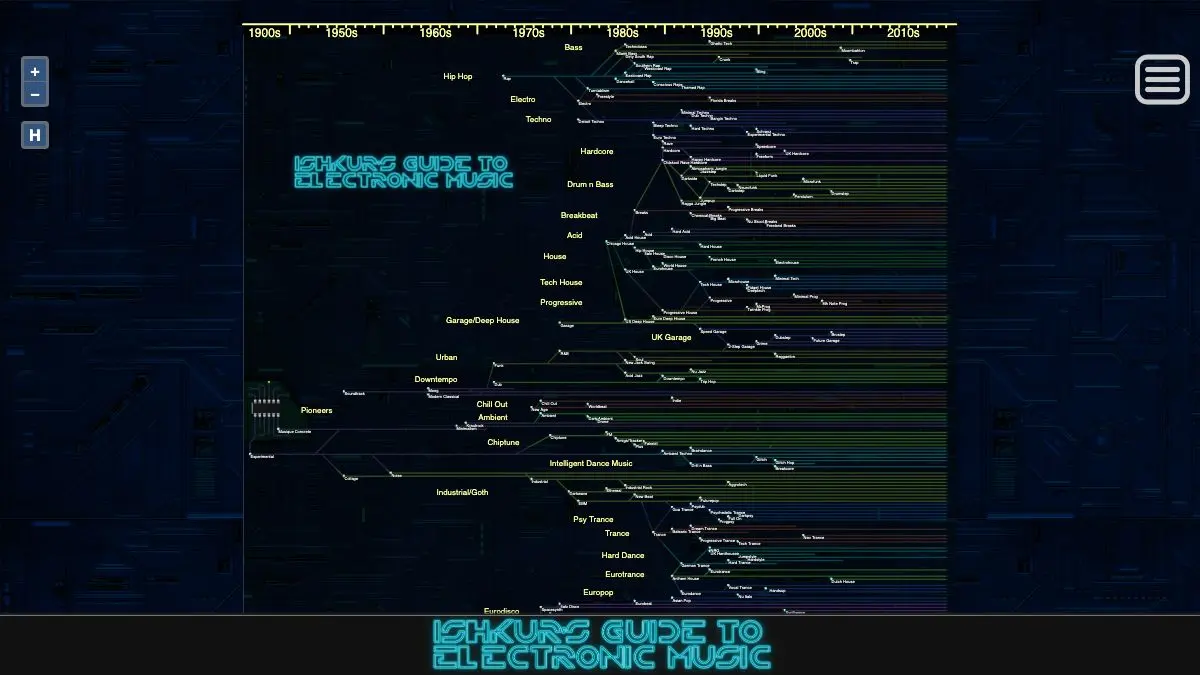
Ishkur’s Guide to Electronic Music is a family tree of every electronic subgenre anyone has ever named, laid out on a timeline, annotated with strong opinions, and, crucially, playable. Click a branch and it tells you what the genre is, when it split off, what it split off from, and then plays you tracks that prove the point. It is part reference work, part argument, part several hours you did not plan to spend.
What is Ishkur’s Guide?
In the early 2000s a Flash file started circulating that attempted to chart the entire genealogy of electronic music. It was dense, it played audio clips, and its genre descriptions were funny in a way that reference material almost never is. For a large number of people it was the thing that made electronic music legible, the moment you understood that jungle and drum and bass were related but not identical, that trance had split into six mutually hostile factions, and that most genre arguments are about a specific two-year window in one city.
Flash died. The guide came back, rebuilt from scratch as a modern web application with far more genres, far more music, and a proper timeline. This version is bigger in every dimension: hundreds of genres, thousands of tracks, and a structure that lets you follow influence forward and backward through time.
The core insight of the design is that genre names are useless as text and obvious as sound. You can read a paragraph about the difference between hardcore and gabber and retain nothing. Hear thirty seconds of each and the distinction is permanent. Every node in the tree comes with examples, so the guide teaches by ear rather than by definition.
Then there is the voice. Ishkur is not a neutral encyclopedist. Genres he considers derivative get told so. Scenes he considers self-important get taken apart. Some entries are affectionate, some are hit jobs, and the tone is closer to a very well-read friend who has been to too many clubs than to a wiki. This is either the best or worst thing about the guide, depending on whether your favorite genre is one of the ones he dislikes.
What survives the jokes is a real structural education. You come away understanding electronic music as a branching process, driven by technology, geography, and drugs, rather than as a list of labels.
What can you do with Ishkur’s Guide?
- Follow a genre’s ancestry. Pick anything and trace it backward through the branches until you hit disco, dub, or a drum machine.
- Listen to every node. Each genre comes with sample tracks, so you can hear the difference instead of arguing about it.
- Read the annotations. Sharp, funny, occasionally unfair, and consistently more memorable than a neutral description would be.
- Use the timeline. Genres are placed in time, which makes the bursts of activity in the late eighties and mid nineties visually obvious.
- Settle arguments. Or start much better ones, since the guide takes positions rather than hedging.
- Discover by adjacency. The most useful move is jumping to the branch next to the one you like, which is where your next favorite thing usually lives.
- Fill gaps in your listening. Almost everyone finds a whole limb of the tree they have simply never explored.
Tips to get the most out of it
Start from something you already love. Find one genre you know well, check whether the description matches your experience, and then use that as calibration for everything else the guide tells you.
Play the samples, do not just read. The written descriptions are entertaining, but the audio is the actual teaching mechanism. A genre you cannot picture becomes obvious after one clip.
Use headphones and turn it up a bit. A lot of what distinguishes these genres is bass weight and drum texture, both of which vanish on laptop speakers.
Take the insults as style, not verdict. If your genre gets mocked, note that almost all of them do at some point. The historical claims and the audio evidence are the substance; the tone is the packaging.
Explore sideways from the branches you avoid. The point of a tree is that neighbors share ancestry. The genre you assume you hate is usually one degree from something you would like.
Give it a proper session. This is not a lookup tool. Set aside an evening, follow one branch to its end, and let the auto-play carry you somewhere unexpected.
If you like Ishkur’s Guide, also try…
- Musicmap: the encyclopedic, all-genres counterpart, calmer in tone and enormous in scope.
- Every Noise at Once: thousands of algorithmically derived genres, each with a playable sample.
- Radiooooo: pick a country and a decade and hear what was actually playing there.
- Forgotify: the opposite approach to discovery, tracks nobody has ever streamed.
The rest of our listening picks live in Music & Audio, and the taxonomy nerds may want Data & Research too.
Frequently asked questions
What is Ishkur's Guide to Electronic Music?
It is an interactive genealogy of electronic music genres, built by a writer known as Ishkur. Genres are arranged as branches on a timeline, each one with a written description and playable sample tracks so you can hear what the label actually means. The current version is a full rebuild of a Flash guide that circulated widely in the early 2000s.
Is Ishkur's Guide free to use?
Yes, the guide is free to browse and listen to in a browser, with no account required. It is a personal project rather than a commercial service. All you need is a reasonably modern browser and sound.
Are the genre descriptions accurate?
They are informed and opinionated in roughly equal measure. The historical lineage and the audio examples are genuinely useful for understanding how genres split and recombined, but the commentary is editorial and often deliberately scathing. Treat it as a knowledgeable friend arguing with you, not as a neutral reference work.
How is it different from Musicmap?
Musicmap covers all popular music genres with an encyclopedic, neutral tone and a large visual map. Ishkur's Guide covers electronic music only, goes far deeper into its subgenres, plays you audio for each one, and has a strong personal voice. They complement each other well.
Visit Ishkur's Guide to Electronic Music →
← All posts · Browse the directory