// 2026-08-05 · Data & Research · by Bob Smith
Quiver Quantitative Congress Trading: Every Stock Trade Congress Discloses
Quiver Quantitative turns the disclosure filings of US senators and representatives into a searchable feed of stock trades, by legislator and by ticker.
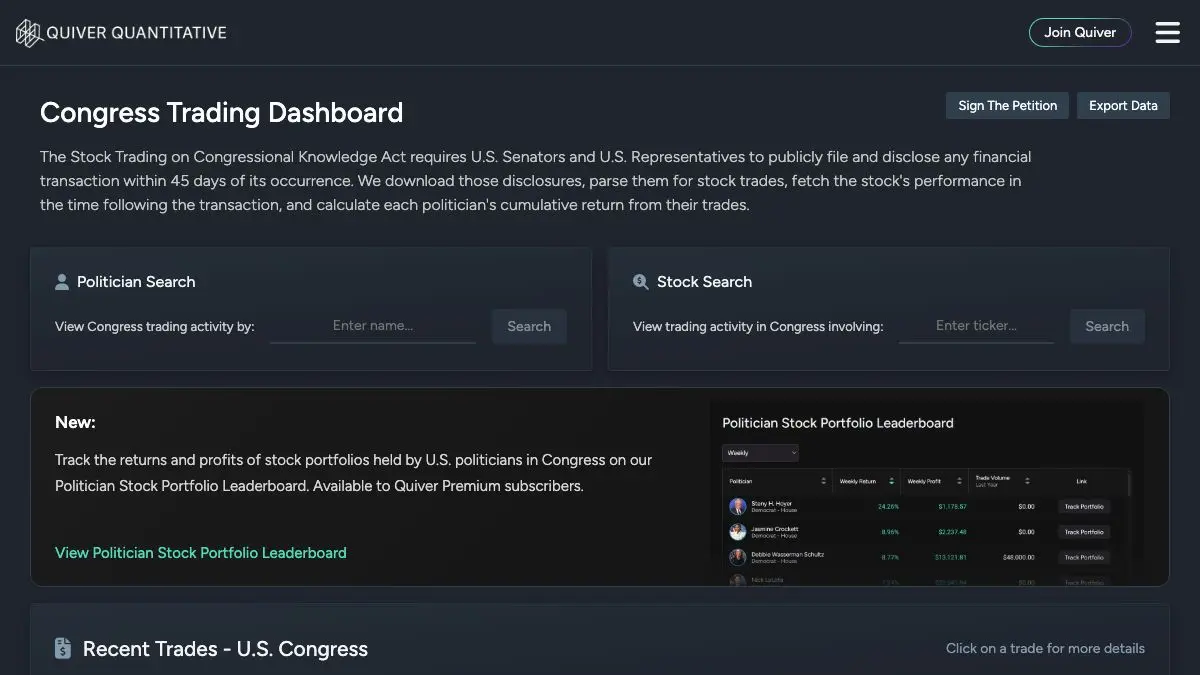
Quiver Quantitative’s Congress Trading page takes a pile of legally mandated PDF disclosures and turns them into something a normal person can actually read: a searchable list of which members of the US Congress bought and sold which stocks, and when.
The filings have always been public. They have also always been scattered, awkwardly formatted and effectively invisible. This page is what happens when someone does the parsing work.
What is the Congress Trading tracker?
Under the STOCK Act, members of Congress must disclose their securities transactions publicly, within a defined window, in filings that name the asset, the transaction type and a value range. The law was passed to make congressional trading visible. It succeeded at the letter of that goal and, for a long time, failed at the spirit, because “public” meant a searchable-in-theory archive of scanned forms.
Quiver Quantitative is an alternative-data company that builds dashboards out of unconventional public datasets, and congressional trading is its best-known one. The site ingests the filings, extracts the transactions, and presents them three ways: a live feed of the most recent disclosures, a page per legislator, and a page per ticker.
The per-legislator view is the one people arrive for. Pick a name and you get their disclosed trading history, the tickers involved, buy or sell, and the dates. The per-ticker view is the one that produces the more interesting questions — search a defense contractor or a pharmaceutical company and see which legislators have traded it, which occasionally lines up uncomfortably with committee assignments.
Two caveats are essential and the site does not hide them. First, disclosure values are reported in broad ranges, not exact amounts, because that is what the law requires. Second, the data is retrospective. Filings arrive after the fact, sometimes long after, so this is a record of what happened rather than a signal about what is about to.
The broader context is that congressional stock trading remains legal and contentious. Bills to ban it appear regularly. In the meantime, the disclosures are what exist, and this is the most convenient way to read them.
What can you do with it?
- Browse the live feed. The newest disclosures appear in reverse chronological order, with legislator, ticker, transaction type and dates.
- Search by legislator. Every member with filings gets a page listing their disclosed transactions over time.
- Search by ticker. Pull up a company and see every disclosed congressional trade in it, which is the more revealing direction.
- Compare transaction and disclosure dates. The gap between the two is displayed, and it is frequently the most interesting column on the page.
- See value ranges. Amounts are shown as the legally required brackets rather than exact figures.
- Filter by chamber and party. Useful for spotting patterns rather than anecdotes.
- Cross-reference with committee membership. Not automated, but the ticker view plus a quick look at which committee a member sits on is where most of the reporting on this subject starts.
- Explore Quiver’s other datasets. Government contracts, lobbying spend and similar public-record feeds live on the same site.
Tips to get the most out of it
Read the disclosure date, not just the trade date. A transaction reported months late tells you something on its own, and it also means anyone treating the feed as a real-time signal is trading on stale information.
Search by ticker rather than by name. Starting from a company and seeing who traded it surfaces patterns that browsing individual legislators will not, because you are no longer limited to the names you already suspected.
Remember the amounts are ranges. A disclosure covering a wide bracket is not a precise figure, and totals built by summing midpoints are estimates. Treat any dollar total as approximate.
Check who actually made the trade. Disclosures can cover a spouse or dependent child, not only the member. That distinction matters and is easy to skim past.
Do not mistake this for a trading strategy. Copy-trading congressional disclosures is a popular idea and a structurally difficult one, because you are acting on information that is by definition already old and public.
Go back to the original filing for anything serious. Quiver is a parser, and parsers make mistakes. The underlying House and Senate disclosure archives are public, and citing the source rather than the dashboard is the right move for anything you publish.
If you like Quiver Quantitative, also try…
- LittleSis: who the powerful know, mapped from board seats and donations.
- Violation Tracker: corporate fines and settlements, aggregated to the parent company.
- ImportYeti: public customs records revealing who actually supplies whom.
- judyrecords: a free full-text search across hundreds of millions of US court cases.
More public records made usable in Data & Research.
Frequently asked questions
What is Quiver Quantitative's Congress Trading tracker?
It is a free web dashboard that collects the stock transaction reports US senators and representatives are legally required to file, and presents them as a searchable, sortable database. You can browse by legislator, by ticker, or as a chronological feed of the newest disclosures. The underlying filings are public records; Quiver's contribution is parsing them into usable data.
Is it legal for members of Congress to trade stocks?
Yes, with conditions. The STOCK Act requires members of Congress to publicly disclose covered securities transactions within a set filing deadline and prohibits trading on non-public information obtained through their official position. Enforcement of the disclosure deadline has been widely criticized as weak, and proposals to ban congressional stock trading outright have been introduced repeatedly without passing.
Is Quiver Quantitative free?
The congressional trading dashboard is free to browse without an account. Quiver also sells paid subscription tiers and API access that add features like alerts, bulk data export and additional alternative datasets.
How current is the data?
It is only as current as the filings themselves, which arrive after the trade rather than before it. Disclosures are due within a legally defined window after a transaction, and late filings are common, so a trade may appear on the site weeks after it happened. The site generally shows both the transaction date and the disclosure date so you can see the gap.
Visit Quiver Quantitative — Congress Trading →
← All posts · Browse the directory