// 2026-08-05 · Data & Research · by Bob Smith
Violation Tracker: A Searchable Rap Sheet for Corporations
Violation Tracker collects US corporate fines, settlements and penalties into one free database, aggregated up to the parent company that owns the offender.
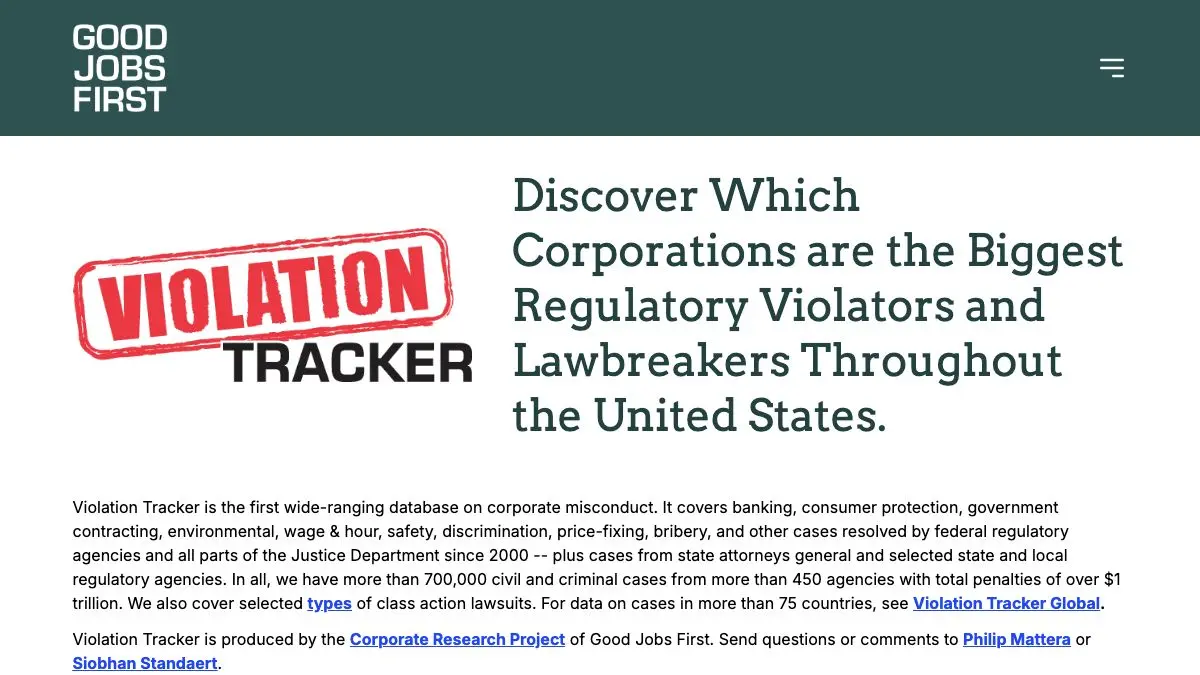
Violation Tracker is a corporate rap sheet. Type in a company name and it returns the fines, settlements and penalties that company and its subsidiaries have racked up across dozens of US regulatory agencies, with amounts, dates, offense types and links to the source documents.
The important word is subsidiaries. Enforcement records are filed against whichever legal entity happened to be on the paperwork, which is why a conglomerate’s misconduct usually looks like a scattering of unrelated small companies. Violation Tracker undoes that.
What is Violation Tracker?
The information was never secret. The EPA publishes its enforcement actions. So does OSHA, the SEC, the CFPB, the Department of Justice, state attorneys general, and a long list of others. Anyone could look any of it up.
What nobody could do was add it together. Agency databases do not talk to each other, they use inconsistent company names, and — the real obstacle — the entity fined is rarely the household name that owns it. A penalty against some regional subsidiary with an unmemorable name does not obviously connect to the parent whose logo is on the building.
Good Jobs First, a nonprofit that has spent years tracking corporate subsidies and accountability, built Violation Tracker to solve that. The database ingests enforcement records from a wide range of federal and state agencies, then does the tedious ownership research required to attribute each one to its ultimate parent company. The result is a single search box where a company name returns its consolidated record.
Each entry shows the offending entity, the parent, the agency, the year, the penalty amount, the offense group — environmental, workplace safety, wage theft, consumer protection, financial, healthcare fraud and so on — and generally a link back to the agency’s own document.
The scope is US-focused, and it is complemented by companion projects from the same organization covering government subsidies and corporate ownership structures. Together they answer a pointed pair of questions about any large company: what has it been penalized for, and how much public money has it received.
The experience of using it is fairly specific. You look up a company you have some feeling about, you sort by penalty amount, and then you sit with the results for a moment.
What can you do with Violation Tracker?
- Search any large US company. Results roll up subsidiaries automatically, so you see the parent’s full record rather than a fragment.
- Filter by offense type. Narrow to environmental, workplace safety, wage and hour, consumer protection, financial or any other category.
- Filter by agency. See only EPA actions, only OSHA actions, only DOJ settlements, and so on.
- Filter by year and by penalty size. Useful for asking whether a company’s record is historic or ongoing.
- Sort by penalty amount. The largest single actions are usually the ones with a story attached.
- Filter by state or industry. Handy for local reporting, or for looking at a sector rather than a single firm.
- Click through to the source. Most entries link to the originating agency record so you can verify and read the detail.
- Explore the companion databases. The same organization publishes subsidy tracking and corporate ownership data that pair naturally with this.
Tips to get the most out of it
Search the parent, then look at the subsidiary column. Half the value is discovering which unfamiliar entity names actually belong to a company you know. That column is a small education in corporate structure.
Filter by offense type before drawing conclusions. A large total driven by one antitrust settlement means something quite different from the same total accumulated across hundreds of workplace safety citations.
Watch the date range. A company with a bad record that ends abruptly a decade ago is a different story from one still accumulating penalties. Sort chronologically before deciding which story you are telling.
Remember absence is not innocence. The database covers a large but finite set of agencies and years. A clean result may mean a clean record, or may mean the relevant regulator is not among the sources.
Compare penalties against company size. A headline-sized fine can be a rounding error on a large balance sheet. The absolute number is only half the picture.
Verify before you publish. Aggregation introduces errors. The source links are there for a reason, and citing the agency record rather than the aggregator is the safer move.
If you like Violation Tracker, also try…
- LittleSis: the network of people and boards behind the companies in this database.
- judyrecords: free full-text search across a vast archive of US court records.
- ImportYeti: customs data revealing which factories actually supply which brands.
- Terms of Service; Didn’t Read: what companies are doing to you legally, as opposed to illegally.
More accountability data in Data & Research.
Frequently asked questions
What is Violation Tracker?
Violation Tracker is a free database of corporate misconduct in the United States, compiled by the nonprofit research group Good Jobs First. It gathers enforcement actions — fines, penalties, settlements and judgments — from a large number of federal and state agencies and links each one to the parent company that ultimately owns the entity involved. That parent-company linkage is the feature that makes it different from reading agency press releases one at a time.
Is Violation Tracker free?
Yes, searching and browsing the database is free and requires no account. Good Jobs First is a nonprofit funded by grants, and it also maintains related free databases on subsidies and corporate ownership.
What kinds of violations does it cover?
A broad range: environmental, workplace safety, wage and hour, consumer protection, financial and banking, healthcare fraud, antitrust, employment discrimination, food and drug safety and more. Each entry names the agency, the year, the penalty amount and the offense category, and usually links to the agency source document.
Can I use Violation Tracker for research or journalism?
It is designed for exactly that. Entries carry sources you can verify, results can be filtered and exported, and the parent-company rollup makes it possible to answer questions like a company's total penalties across every agency. As with any aggregated database, confirming a specific figure against the original agency record before publishing is good practice.