// 2026-08-05 · Privacy & Security · by Bob Smith
Terms of Service; Didn't Read: The Fine Print, Graded and Translated
ToS;DR summarizes the terms of service of major websites into plain-English points and letter grades, so you can find out what you agreed to without reading 40 pages.
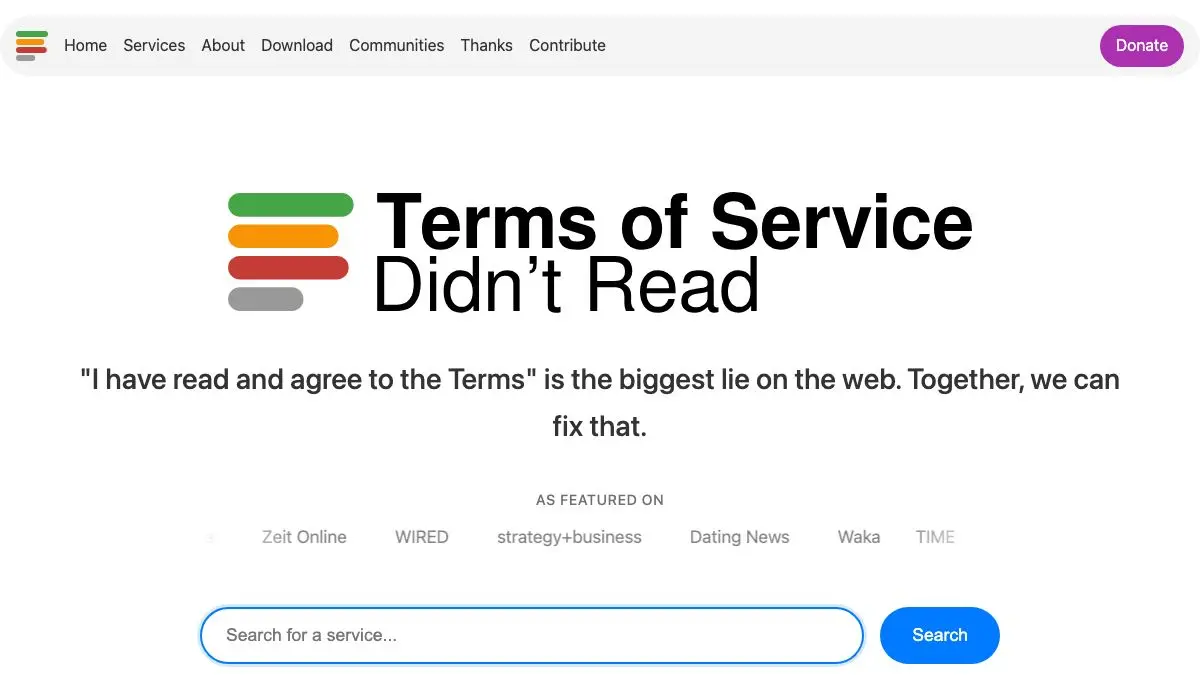
Terms of Service; Didn’t Read exists because of a specific, universal lie. You have told hundreds of companies that you read and agreed to their terms. You have read approximately none of them. ToS;DR reads them instead, chops them into individual points a normal person can understand, marks each one as good or bad for you, and gives the service a grade from A to E.
Then you find out that the app you have had on your phone for six years claims a perpetual license to everything you upload.
What is ToS;DR?
The project started around 2012 with a slogan that has aged extremely well: “I have read and agree to the Terms” is the biggest lie on the web. The founders’ insight was that nobody was ever going to read a 12,000-word agreement written by lawyers to be unreadable, so the fix had to be structural, not moral. Summarize it once, publicly, and let everyone benefit.
The unit of work is the point, not the essay. A contributor finds a specific clause, quotes the actual sentence from the document, and states in one line what it means: this service can delete your account without notice, this service tracks you across other websites, this service promises to notify you before transferring your data to a new owner. Each point is tagged good, bad, neutral or blocker, and then reviewed by other contributors before it counts.
Grades run from A to E. An A means the terms treat users notably well, an E means they are among the worst reviewed. Plenty of services sit unrated or partially rated, because volunteer capacity is finite and there are a great many terms of service in the world. The site is honest about this, showing you when a service’s analysis is incomplete rather than pretending to a verdict it has not earned.
What makes it trustworthy is the receipts. Every point links back to the quoted source text, so you are never asked to just believe a summary. If you disagree with a classification, you can see what it was based on and argue about it in the open.
There is also a browser add-on that puts the grade in front of you while you are on the site, which is the moment it is useful rather than three years later when you are trying to cancel something.
What can you do with ToS;DR?
- Look up any major service. Search a name and get its grade plus the list of approved points, sorted by how much they matter.
- Read the bad points first. Each service page separates the clauses that work against you, which is the fastest possible way to learn what you signed up for.
- See the original wording. Every point cites the sentence it came from, so you can check the interpretation instead of trusting it.
- Compare competitors. Deciding between two email providers or two cloud drives is much easier when you can see both sets of terms side by side in summary form.
- Install the add-on. The browser extension shows a service’s grade as you browse, so the information arrives before you click the checkbox.
- Find the universal red flags. Recurring points, such as terms that can change without notice or broad content licenses, show you how common a practice really is across the industry.
- Contribute a point. Anyone can submit a quoted clause with a proposed rating, and the review process is public.
- Use the open data. The project publishes its dataset and API, so the ratings can be pulled into other tools.
Tips to get the most out of it
Check the coverage before you trust the grade. Some services have hundreds of reviewed points, others have a handful. A page that says the analysis is incomplete is telling you something real, and the grade should be weighted accordingly.
Look at the date on the points. Terms change, sometimes substantially, and a point approved several years ago may describe a document that has since been rewritten. The quoted source is your check.
Read the good points too. It is easy to use ToS;DR purely as an outrage generator. The A-graded services exist, and knowing which companies commit in writing to notifying users before a data transfer is genuinely useful when choosing where to keep things.
Use it before signing up, not after. The whole value is in the thirty seconds before you create an account. Once your photos are uploaded, the perpetual license discussion is academic.
Pair it with a tracker scan. Terms tell you what a company says it does. A scan tells you what its pages actually do. The two together give a much fuller picture than either alone.
If you like ToS;DR, also try…
- Blacklight: scans a site to show what it actually does, as a counterpart to what its terms claim.
- JustDeleteMe: a directory of how hard each service makes it to close your account, rated by difficulty.
- Privacy Guides: once you know which services treat you badly, here are the ones that do not.
- Have I Been Pwned: the consequences, catalogued, when a company’s data handling goes wrong.
More reading-the-fine-print tools in Privacy & Security, and more genuinely useful references in Tools & Utilities.
Frequently asked questions
What is Terms of Service; Didn't Read?
Terms of Service; Didn't Read, usually shortened to ToS;DR, is a community project that reads the terms of service and privacy policies of online services and breaks them into short, plain-English points. Each point is rated as good, bad or neutral for the user, and services receive an overall grade from A to E. The stated goal is to fix what the project calls the biggest lie on the web: the checkbox that says you have read the terms.
Is ToS;DR free?
Yes. The site is free to browse, the analyses are contributed and reviewed by volunteers, and the project is run as a nonprofit initiative rather than a commercial service. There is also a browser add-on that surfaces a service's grade while you browse.
How are the grades decided?
Volunteers read a service's documents, quote the relevant passages, and submit each as a discrete point with a proposed classification. Other contributors review and approve those points before they count. The overall grade is derived from the approved points, which is why some services show a full grade while others are still marked as having insufficient analysis.
Is ToS;DR legal advice?
No. It is a summary and interpretation produced by volunteers, not lawyers acting for you, and terms change over time. Treat it as a fast way to find the clauses worth knowing about, then read the quoted original text yourself if something matters for a real decision.
Visit Terms of Service; Didn't Read →
← All posts · Browse the directory