// 2026-08-05 · Learning & Education · by Bob Smith
The Physics of the Universe: Cosmology Explained Without the Math
A one-man reference site that walks through the Big Bang, black holes, quantum theory and relativity in plain English, with a glossary and a full timeline.
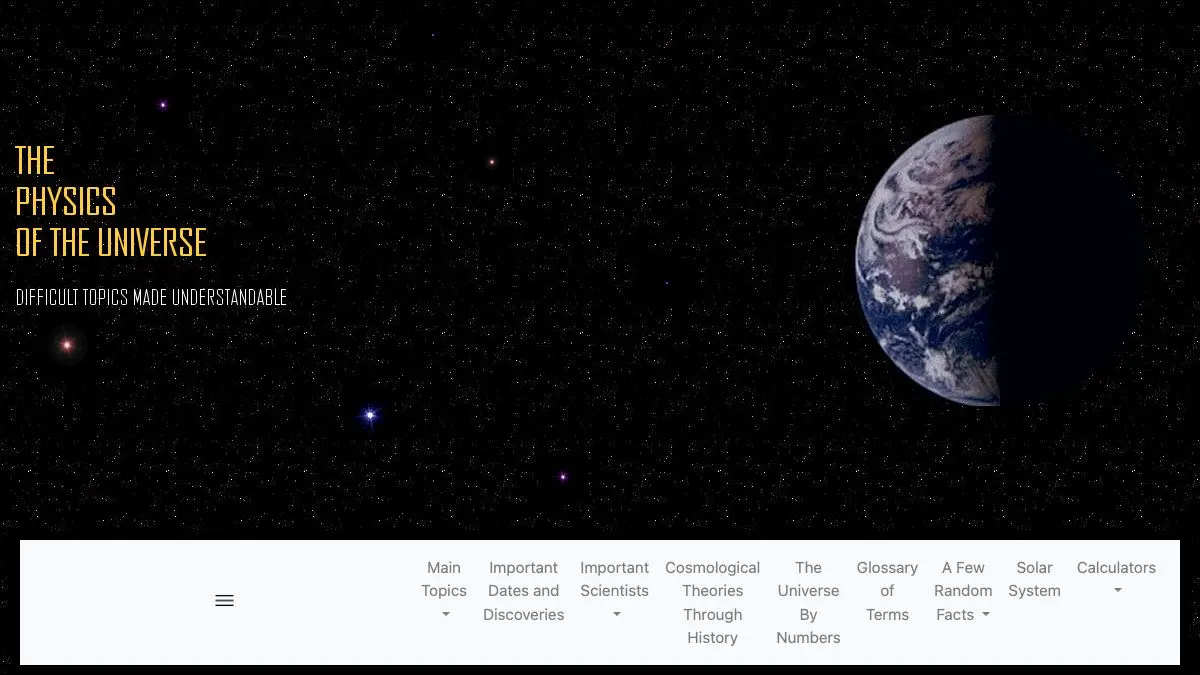
The Physics of the Universe is what happens when someone decides the general public deserves a proper explanation of cosmology and then simply writes one. No equations. No ads competing for your attention. No editor telling the author to lead with a quiz. Just a long, patient, well-organized walk through the strangest ideas in science, written for a reader who is smart but has never taken a physics class.
What is The Physics of the Universe?
Popular science tends to arrive in two unhelpful sizes. There are the breathless articles that use the word “mind-bending” four times and explain nothing, and there are the textbooks that assume you already know what a tensor is. The gap between them is enormous, and it is where most curious people give up.
This site sits squarely in that gap. It is a personal reference project, built by one author, that takes the major territories of modern physics and works through them in sequence: the Big Bang and the expanding universe, black holes and wormholes, quantum theory, special and general relativity, and the pile of things nobody has settled yet.
The structure is the good part. Each main topic gets a short overview, then breaks into subsections you can read in order like chapters, or jump into individually when a term ambushes you somewhere else. Alongside the main sections there is a glossary, a chronological timeline of physics discoveries, and short biographies of the people who made them.
The tone is calm and slightly old-fashioned in the best sense. It reads like a good encyclopedia entry expanded to the length it actually needed. Where a concept is genuinely contested, the site says so rather than picking a side and pretending the argument is over.
It also looks like it was built around 2009 and has not been redesigned since, which is a feature. The text loads instantly, the navigation is a list of links, and nothing slides in from the side asking you to subscribe.
What can you do with The Physics of the Universe?
- Read a topic end to end. Pick a main section and work through its subsections in order. Each one builds on the last, so you end up with a genuine mental model rather than a handful of facts.
- Look up a term you keep hitting. The glossary covers the vocabulary that popular articles use without defining: event horizon, decoherence, redshift, inflation, singularity.
- Follow the timeline. A chronological list of major physics discoveries, from antiquity forward, which is unusually good at showing how long some ideas took to arrive.
- Read the biographies. Short profiles of the physicists behind the theories, useful for understanding why a particular idea was radical at the time.
- Get to grips with relativity. The relativity section is one of the strongest, working carefully through the thought experiments rather than just asserting the conclusions.
- See what is still unsolved. A section on open problems, which is where a lot of the interest actually lives.
- Send it to someone. It is a good link for the friend who asked a genuine question about black holes and deserves better than a video essay.
Tips to get the most out of it
Start with the topic that annoys you most. Everyone has one concept they have had explained badly several times. Go straight to that section rather than starting at the beginning out of politeness. The site is built to be entered anywhere.
Read the main topic page before the subsections. Each section opens with an overview that frames what follows. Skipping it makes the subsections feel like disconnected facts, which is exactly the problem the site exists to solve.
Keep the glossary open in a second tab. The prose is careful about defining terms, but you will still hit words carried over from earlier sections. A quick glossary check keeps you from rereading three paragraphs.
Use the timeline for context, not for study. It is a browsing tool. Skim it once early on and you will have a rough map of when everything happened, which makes the later reading noticeably easier.
Treat it as a companion, not a course. It will not teach you to solve problems. Pair it with a real course or textbook and it does an excellent job of explaining what the math is actually about.
Don’t rush the relativity chapters. They are the sections that reward slow reading most, and the ones where skimming leaves you with the illusion of understanding.
If you like The Physics of the Universe, also try…
- The Feynman Lectures on Physics: the canonical version of the same instinct, free and complete online.
- Bartosz Ciechanowski: explanations of physical systems built around interactive diagrams you can drag.
- BetterExplained: the same plain-English treatment applied to mathematics.
- Scale of the Universe: the sizes involved, shown rather than described.
More patient explainers in Learning & Education.
Frequently asked questions
What is The Physics of the Universe?
It is a free educational website that explains modern physics and cosmology for a general audience. It covers the Big Bang, black holes, quantum theory, relativity and the main unsolved problems, organized into sections you can read in order or dip into. It is written as a plain reference rather than a blog, so there is no feed to keep up with.
Is The Physics of the Universe free?
Yes. The entire site is free to read, with no account, paywall or newsletter signup. It is a personal project rather than a commercial publication.
Do I need math to read it?
No. The site deliberately avoids equations and works through ideas in prose instead. A few formulas appear where they are unavoidable, but you can follow the arguments without doing any calculation yourself.
Is it a good starting point for learning physics?
It works well as a conceptual orientation before or alongside a real course. It gives you the vocabulary, the historical sequence and a sense of what the open questions are, which makes textbooks and lectures much easier to follow afterward.
Visit The Physics of the Universe →
← All posts · Browse the directory