// 2026-08-05 · Tools & Utilities · by Bob Smith
TypeRacer: Competitive Typing Against Actual Humans
TypeRacer drops you into a live race against other people, typing a passage as fast as you can. Free, browser-based, and quietly addictive for years.
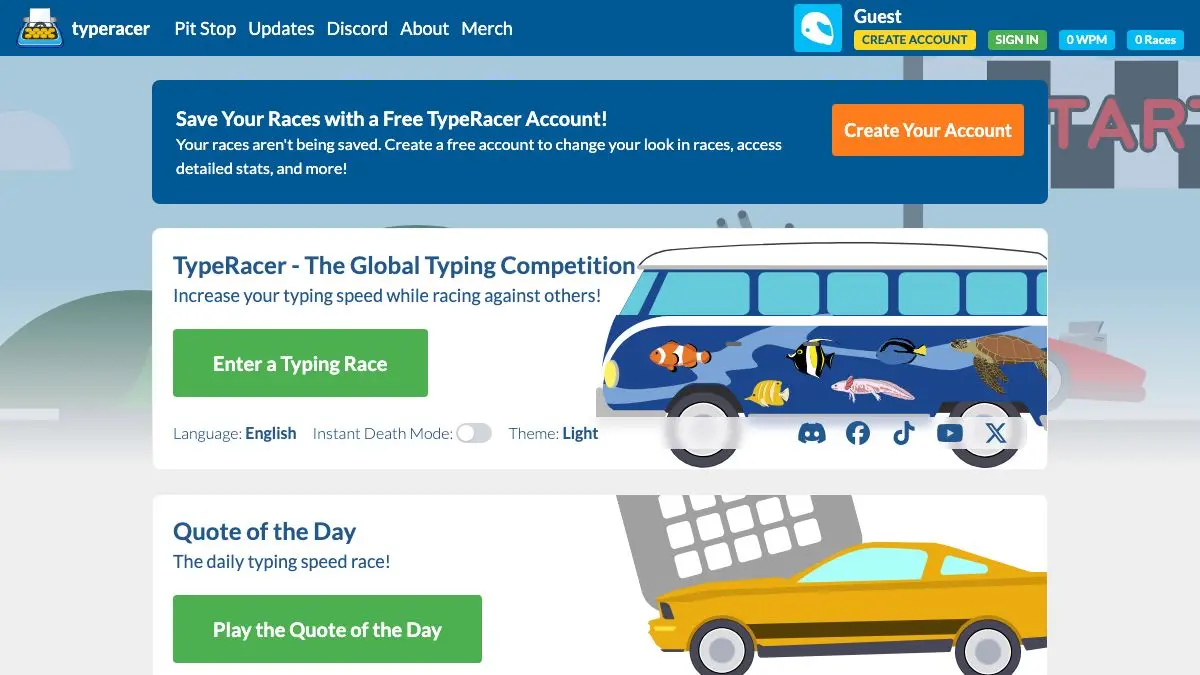
TypeRacer is a typing test with an audience. You load the page, a passage appears, a countdown runs, and then you and several strangers race little cars across the screen by typing. It has looked more or less the same since 2008, it has no tutorial, and it is one of the most effective typing trainers ever made, largely by accident.
What is TypeRacer?
The mechanic is simple enough to explain in a sentence. Everyone in the race sees the same text. You type it. Your car moves in proportion to your progress, and so does everyone else’s. First to the end wins. Your score is words per minute, calculated at the finish.
The detail that makes it work is that TypeRacer will not let you type past a mistake. Get a character wrong and the input locks until you back up and fix it. There is no plowing ahead and hoping. This turns accuracy from a nice-to-have into a hard constraint, which is exactly the right lesson, because in real typing a typo costs you more time than typing slowly ever would.
The passages are quotes rather than generated word lists. Lines from novels, films, songs, speeches. This matters more than it sounds. Random common-word drills train you on a vocabulary you never actually type; real prose has capital letters, commas, apostrophes, semicolons and the occasional word you have to read twice. Those are the things that break your rhythm in practice, so those are the things worth practicing.
And then there is the racing. Watching three other cars pull ahead of yours produces an urgency that no solo test replicates. It is entirely artificial, the opponents are strangers you will never meet again, and it works completely. People who cannot make themselves do ten minutes of typing drills will happily run twenty races.
Accounts are free and worth making, because the site keeps your history. Average speed, best speed, a graph of your progress, and a breakdown of which races went badly. Watching the average creep up over months is its own reward, and it is the reason people who signed up in 2011 are still there.
What can you do on TypeRacer?
- Race strangers. The default mode. Join a public race, get matched with whoever is waiting, and go.
- Practice solo. Race against nobody when you want to work on a weak spot without the pressure.
- Race against your own ghost. Compete with a replay of your previous run, which is a surprisingly brutal opponent.
- Create a private race. Generate a link, send it to friends or coworkers, and settle the argument about who is fastest.
- Track your stats. A free account records every race, your average WPM, accuracy, and progress charts over time.
- Watch race replays. Playbacks show keystroke by keystroke where time was lost, usually to one word you keep getting wrong.
- Enter the pit stop and leaderboards. Global rankings, universe-specific boards, and the humbling experience of seeing what 180 words per minute looks like.
- Switch text universes. Alternative text pools exist for other languages and for code, if quotes from films are not your target vocabulary.
Tips to get the most out of it
Slow down to speed up. The fastest way to improve your average is to stop making errors, not to type harder. A clean run at 60 beats a messy run at 80 every time, because the correction penalty is enormous.
Read one word ahead. Good typists are always looking slightly past what their fingers are doing. Consciously practicing that lookahead is the single biggest technique change available to most people.
Do not look at the other cars. They are a motivator before the race and a distraction during it. Your eyes belong on the text.
Run short sessions, often. Ten races a day beats a hundred on Sunday. Typing is motor memory, and motor memory prefers frequency over volume.
Use replays on your worst races. The playback almost always reveals the same two or three problem sequences. Fixing a specific finger transition is far more productive than vaguely trying to go faster.
Make a private race for your team. Nothing generates enthusiasm for typing practice like a coworker discovering they are slower than they assumed.
If you like TypeRacer, also try…
- Monkeytype: the minimalist, deeply customizable typing test for solo practice.
- Keybr: an algorithmic trainer that targets your weakest keys specifically.
- TypeLit.io: type your way through entire classic novels instead of racing.
- Hacker Typer: typing with no accuracy requirement whatsoever, for when you need a break.
More keyboard-adjacent picks in Tools & Utilities, and more ways to lose an afternoon in Entertainment & Fun.
Frequently asked questions
What is TypeRacer?
TypeRacer is a browser-based typing game where you race other people in real time. Everyone in the race gets the same passage, usually a quote from a book, film or song, and little cars advance across the screen as you type. Whoever finishes first wins, and your speed is recorded in words per minute.
Is TypeRacer free?
Yes, racing is free and you can play without an account. Creating a free account lets you track your average speed, race history and progress over time. There is also an optional premium tier that adds extra features, but the core game does not require it.
Does TypeRacer actually improve your typing?
It helps, mainly because it makes practice something you want to do. Racing real people creates pressure that pure drills do not, and typing full sentences with punctuation is closer to real writing than isolated word lists. For fixing specific weak keys, a structured trainer is more efficient, but TypeRacer is far better at getting you to practice at all.
What is a good words per minute score on TypeRacer?
Casual typists tend to land somewhere in the 40 to 60 words per minute range, regular users often reach 70 to 90, and the top of the leaderboard goes well past 150. Accuracy matters more than raw speed, since a single mistyped character has to be corrected before the race will continue.