// 2026-08-05 · Design & Creativity · by Bob Smith
Behance: Where Designers Show Their Work
Behance is Adobe's portfolio network for designers, illustrators and photographers. Browse millions of projects, build a free portfolio, and find freelance work.
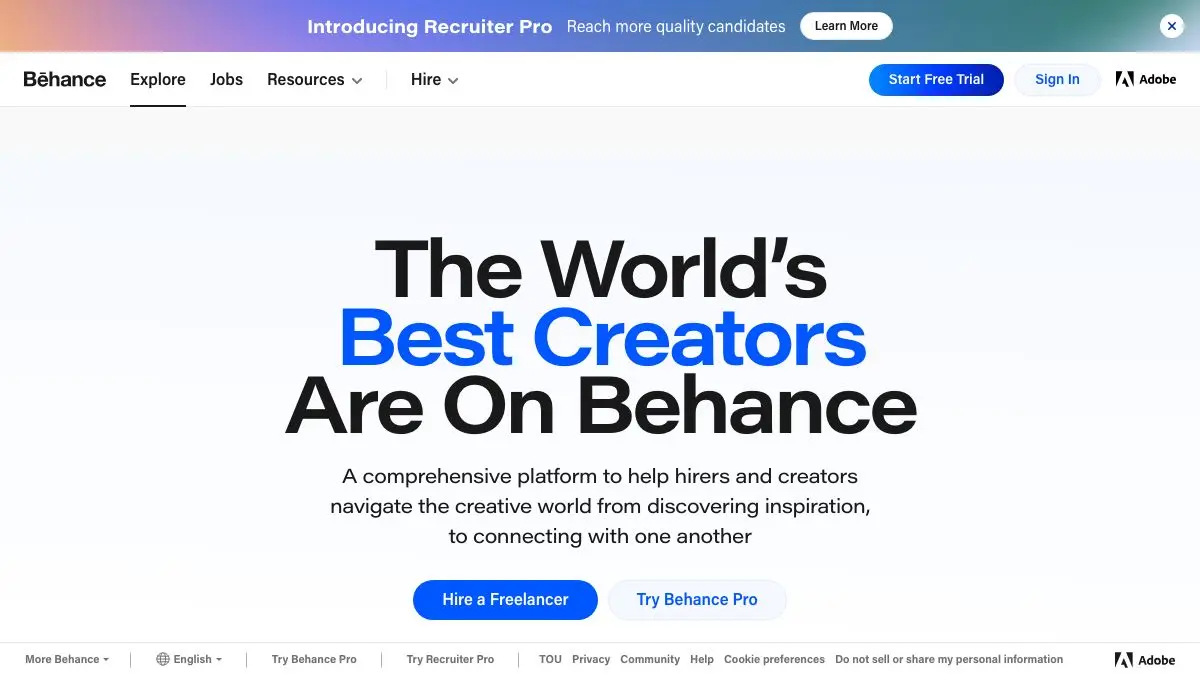
Behance is where the design world puts its portfolio. Millions of projects, from brand identity systems for companies you have heard of to somebody’s beautifully lit photographs of vegetables, all published as full case studies rather than single images. It is free, it requires no Creative Cloud subscription, and it is one of the few places on the internet where the algorithm is mostly showing you people who are extremely good at something.
What is Behance?
Behance launched in 2006, founded by Scott Belsky and Matias Corea, at a moment when a designer’s portfolio was still typically a personal website that took a weekend to build and then rotted for three years. The pitch was simple: give creative people a place to publish work that looks good by default, and give everyone else a place to find them.
Adobe acquired it in 2012. In practice that has meant tighter integration with Creative Cloud, publishing straight from Photoshop and Illustrator, and a large, permanent audience, without the site turning into a subscription upsell. The core function is still free.
The unit of Behance is the project, not the image. A project is a scrollable page: hero shot, then the work, then usually the process, sketches, rejected directions, typography specimens, mockups on actual objects. Good ones read like a short essay in pictures. This is the real difference between Behance and a feed of pretty pictures, you get to see how something was arrived at.
It spans more disciplines than people expect. Graphic design and illustration dominate, but there is serious depth in photography, industrial design, motion graphics, 3D and architectural visualization, UI/UX, and fine art. The curated galleries are editor-picked rather than purely algorithmic, which keeps the quality bar meaningfully high.
And it works as a hiring network in both directions. Studios post jobs, freelancers mark themselves available, and a lot of work gets found simply because somebody was browsing the packaging design gallery at midnight.
What can you do with Behance?
- Browse by discipline. Filter the feed down to branding, motion, photography, product design, whatever you actually care about, and skip the rest.
- Publish a free portfolio. Unlimited projects, a clean profile page, and a custom URL. No hosting, no template shopping, no weekend lost.
- Study full case studies. The best projects show sketches, iterations and rejected concepts, which is the part you never see in a finished ad.
- Follow people and build a feed. Follow enough working designers and your homepage becomes a genuinely useful stream of current work rather than a greatest-hits reel.
- Find freelancers and jobs. Search by skill, tools and location, or list yourself as available for hire.
- Sort by “Most Appreciated” or “Most Recent.” One shows you the canon, the other shows you what people are making this week. Both are useful for different reasons.
- Save projects to Moodboards. Collect references into named boards, which is what most people actually use the site for.
- Explore Behance Live. Creators stream their process in real time, which is oddly hypnotic and much more instructive than a finished file.
Tips to get the most out of it
Write the case study, not just the images. The projects that get traction explain the brief, the constraint and the decision. Ten silent mockups look like everyone else’s ten silent mockups.
Tag ruthlessly and accurately. Discipline, tools, style, industry. Behance search is how recruiters find people, and untagged work is effectively invisible no matter how good it is.
Lead with your strongest image. The cover thumbnail is the entire pitch in the grid view. Pick the one image that would make a stranger stop scrolling, not the one you are personally most attached to.
Use it as a reference library, not a scroll. Search a specific problem, “annual report layout,” “bilingual packaging,” “wayfinding signage”, and build a moodboard. It is much more useful with a question in hand.
Set your location and availability. The freelance search filters on both. A blank location field quietly removes you from most of the searches that would have found you.
Look at who the good people follow. Following lists are an underrated discovery mechanism. One excellent illustrator’s follows will out-recommend the algorithm every time.
If you like Behance, also try…
- Artvee: high-resolution public domain artwork, endlessly useful as reference and raw material.
- Unsplash: free high-quality photography for when a project needs an image immediately.
- Color Hunt: curated color palettes to steal when the brand board is not coming together.
- Photopea: a free browser-based Photoshop for actually making the work you have been admiring.
More portfolios, tools and eye candy in Design & Creativity.
Frequently asked questions
What is Behance?
Behance is an online platform where creative professionals publish portfolios of their work. Designers, illustrators, photographers, animators and 3D artists post projects as case studies with images, process shots and written notes. It is owned by Adobe and doubles as a discovery feed and a hiring network.
Is Behance free?
Yes. Creating an account, publishing an unlimited number of projects and browsing the whole site are all free, and you do not need an Adobe Creative Cloud subscription. Adobe monetizes it through job listings and its wider ecosystem rather than through portfolio fees.
How is Behance different from Dribbble?
Dribbble grew up around small shots, single screens, an icon, a snippet of interface. Behance is built around full projects, so entries tend to be long-form case studies with multiple images and explanation. If you want to see how a piece of work was made rather than just the final frame, Behance is usually the better place to look.
Can you get hired through Behance?
It happens regularly. The site has a job board and a freelance-hiring section, and recruiters search portfolios directly by discipline, tools and location. A well-tagged, well-presented portfolio with a clear location and availability status does most of the work.