// 2026-08-05 · Music & Audio · by Bob Smith
Hooktheory TheoryTab: The Chord Progressions of Real Songs, Analyzed
TheoryTab is a searchable library of thousands of chord progressions transcribed from real songs, written in a key-independent notation so you can see why they work.
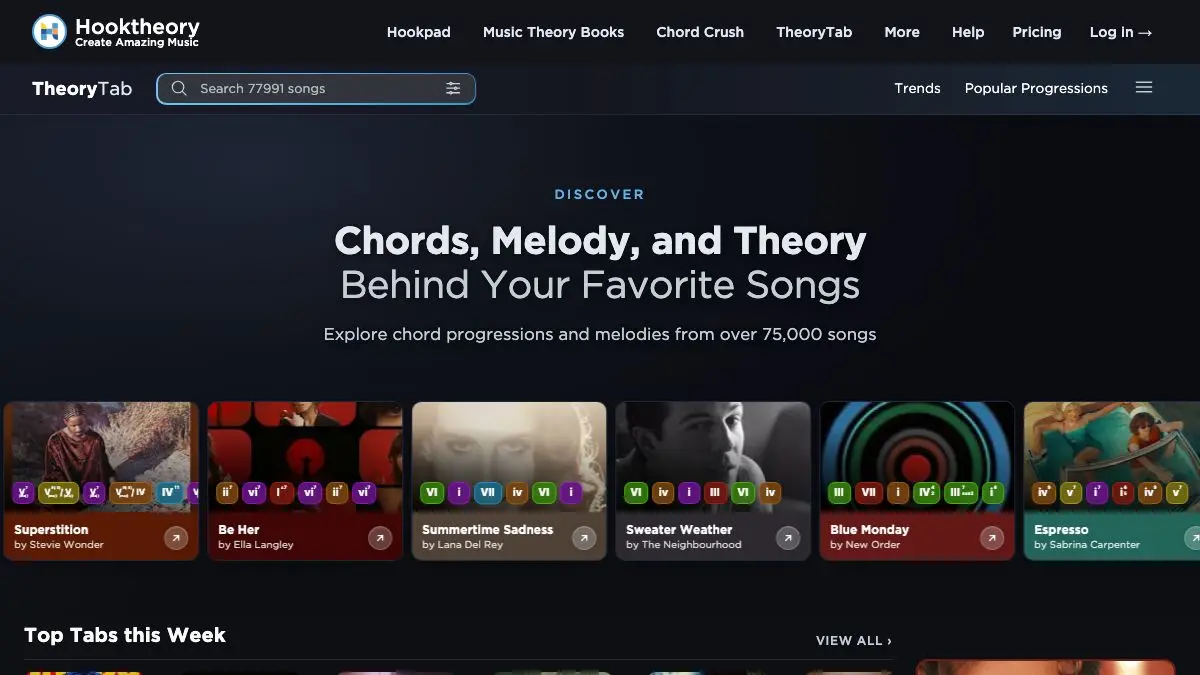
Hooktheory TheoryTab is what happens when a large group of people spend years transcribing pop songs and then someone builds a proper database out of it. Type in a song and you get its chords, its melody, and the structure laid out section by section. Type in a chord progression instead and you get every song in the library that uses it. It is the closest thing the internet has to an index of how popular music is actually put together.
What is TheoryTab?
The core insight is the notation. Guitar tab sites give you letter chords: G, D, Em, C. That’s fine for playing along and useless for comparison, because the same progression in a different key looks like a completely different set of letters. TheoryTab writes chords relative to the key instead, so the tonic is always 1 and the pattern is always the pattern. Suddenly a country song from 1975 and a synth-pop single from last year visibly share a spine.
Each TheoryTab shows the chords as colored blocks along a timeline, with the melody drawn above them on a piano roll. Colors correspond to chord function, so you can read the harmonic shape of a chorus without reading a single symbol. Everything plays back in the browser, and you can transpose it, loop a section, or slow it down.
Entries are split by song section: intro, verse, pre-chorus, chorus, bridge. That matters more than you’d expect, because the interesting harmonic decisions in pop music happen at the seams. Seeing a song swap a minor chord for its major equivalent right as the chorus lands is hard to notice by ear and obvious once it’s drawn.
The library is community-transcribed, which brings the usual tradeoff. Coverage is broad and skewed toward whatever the contributors cared about: a lot of pop, rock, video game music, anime themes, and film scores, with thinner coverage of jazz, classical, and anything harmonically dense. Accuracy is generally good but not guaranteed, and a popular song may have several competing transcriptions.
Around the database sits the rest of Hooktheory: a pair of well-regarded theory books that teach harmony using exactly this notation, and Hookpad, a composition tool that suggests chords based on what the database says usually comes next. The database and the teaching material are designed to reinforce each other, which is why TheoryTab feels less like a reference and more like a course you can browse.
What can you do with TheoryTab?
- Look up a specific song. Search by title or artist and get its sections transcribed, playable, and annotated.
- Search backwards from a progression. Enter a chord sequence and find every song in the library built on it. Excellent for confirming that the thing you just wrote already exists.
- Read the chord-transition statistics. The site tracks which chord most commonly follows which, so you can see the actual probability distribution behind “this sounds right.”
- Transpose anything instantly. Because the notation is key-independent, moving a song into your vocal range or your instrument’s comfortable key takes one click.
- Compare sections side by side. Pull up the verse and the chorus of the same song and watch what changes when the energy lifts.
- Browse by key, mode, or popularity. Useful for finding examples of a specific device, like a borrowed chord or a modal shift, without knowing which song to look for.
- Contribute a transcription. The library grows because people add to it, and the editor is the same one used for the composition tool.
Tips to get the most out of it
Learn the numbering before anything else. Spend ten minutes with the notation and the entire site opens up. Without it you’re just looking at colored rectangles; with it, you can read a song’s harmony faster than you could read sheet music.
Study three songs you love in the same session. The point of a comparative database is comparison. Individually each transcription is a curiosity. Three at once and the shared patterns start jumping out.
Use the reverse search to escape a rut. If you keep writing the same progression, look it up, find what other songs did with it, and steal a substitution. This is the intended use, not a loophole.
Trust it, but verify by ear. Community transcriptions of ambiguous passages can be debatable, particularly where a bass note implies an inversion. If something sounds off, it might be.
Loop the pre-chorus. It’s the section most people skip and the one where the harmonic work usually happens. Pop songs earn their choruses in the eight bars before them.
Pair it with the melody view. The chords get all the attention, but the piano roll above them shows how the melody sits against each chord. The relationship between the two is where the actual songwriting lives.
If you like TheoryTab, also try…
- Chrome Music Lab: hands-on browser experiments that make harmony, rhythm, and timbre tangible.
- Musicmap: a genealogy of popular music genres, showing how styles descend from one another.
- Ishkur’s Guide to Electronic Music: the same obsessive taxonomic energy, aimed at dance music and delivered with far more attitude.
- Every Noise at Once: thousands of named genres, each one playable, mapped by sonic character.
More for the musically curious in Music & Audio, and more things worth learning properly in Learning & Education.
Frequently asked questions
What is Hooktheory TheoryTab?
TheoryTab is a database of chord progressions and melodies transcribed from real songs by a community of contributors. Each entry shows the chords in a key-independent notation alongside the melody on a piano roll, and can be played back in the browser. It is run by Hooktheory, which also publishes music theory books and the Hookpad composition tool.
Is TheoryTab free?
Browsing and playing back TheoryTabs is free, and you can search the database without an account. Hooktheory sells paid products around it, including books and the Hookpad songwriting software, and some features and higher-resolution analysis tools sit behind those. The core library is open to anyone.
What is the notation TheoryTab uses?
Chords are written relative to the key rather than as absolute letter names, using a Roman-numeral-style system where the tonic is 1. That means the same progression looks identical whether a song is in C major or F sharp major, which is what makes patterns across different songs comparable at a glance.
Can I search for songs that use a specific chord progression?
Yes. The site lets you enter a progression and find songs in the database that contain it, and it also shows statistics on which chords most commonly follow a given chord. That reverse lookup is one of the most useful things on the site for songwriters and for anyone curious about why certain sequences recur.